





In recent times, the global financial landscape has witnessed a peculiar confluence of events, with geopolitical tensions in the Middle East juxtaposed against the ever-vibrant oscillations of the stock market. Amidst the backdrop of the escalating conflict between Israel and Iran, financial markets, particularly in the United States, have demonstrated a resilience that has caught the eye of investors and analysts alike. The Standard & Poor’s 500 Index, a barometer for the health of US equities, has indeed navigated these turbulent waters with considerable agility.
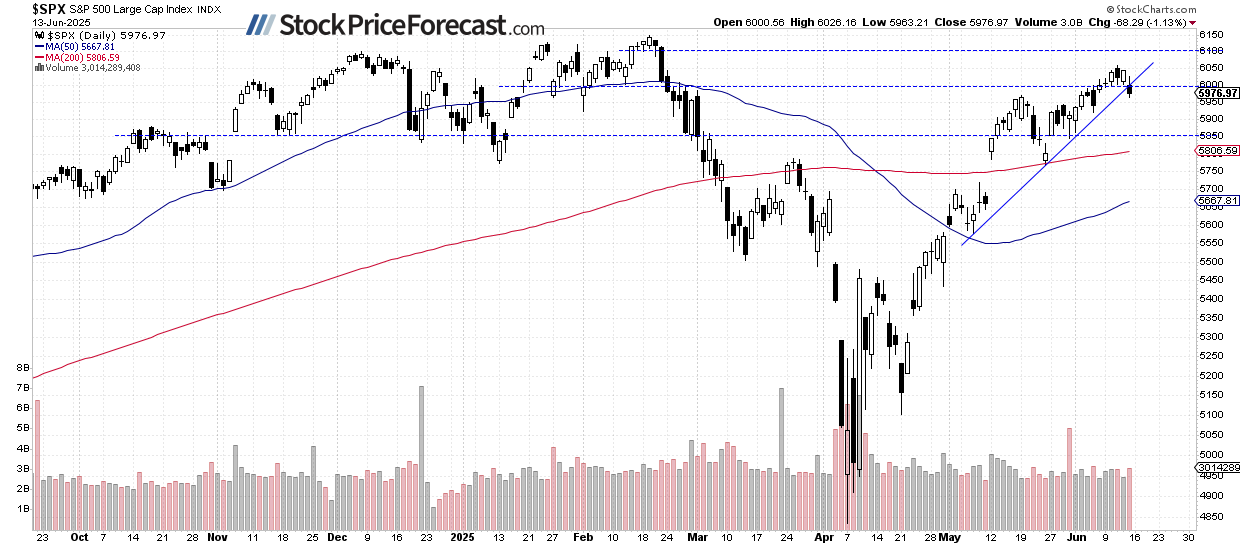
On a day shadowed by intensifying unrest in the Middle East, one might have anticipated a retreat in investor confidence, prompting a downturn in stock prices. Contrary to such expectations, the S&P 500 exhibited a remarkable buoyancy, overcoming an initial stumble to close 0.7% higher after the prior session saw a 1.13% decline. This sequence of events has sparked a debate regarding the durability of the market’s current trajectory, especially in light of the downturn that brought the index below the 6,000 mark just recently.
The fluctuating fortunes of the stock market are often a mirror reflecting a myriad of factors at play, from geopolitical tensions to internal economic indicators. The forthcoming decision by the Federal Open Market Committee (FOMC), expected to be announced on Wednesday, hangs over the market like the sword of Damocles, with potential implications for investor sentiment and market dynamics.
An analysis of investor sentiment preceding these events reveals an intriguing landscape. According to the American Association of Individual Investors (AAII) Investor Sentiment Survey from the previous Wednesday, a bullish sentiment pervaded among 36.7% of individual investors, overshadowing the 33.6% who harboured bearish expectations. This tilt towards optimism, in spite of looming tensions and uncertainties, speaks volumes about the complex interplay of factors driving market perceptions.
Technical analysis of the S&P 500’s movements lends further insight into the underlying currents. A breach of its upward trajectory on Friday signalled potential technical headwinds that could shape future market behaviour. The index’s resilience, closing slightly lower by 0.39% for the week despite achieving a new local high, underscores a robustness in the face of adversity. The persistence of bullish signals, even as resistance looms on the horizon, remains a focal point for technical analysts.
The narrative takes a divergent turn when one considers the Nasdaq 100 Index, which experienced a more pronounced pullback due to weaknesses in the technology sector. The index fell by 1.29% on Friday, reflecting a deeper correction than observed in the broader market. This setback, punctuated by a fall below key support levels, hints at sector-specific vulnerabilities that may have broader implications for the market’s trajectory.
In the realm of market volatility, the Volatility Index (VIX), often referred to as the market’s fear gauge, provides a window into investor sentiment. A surge in the VIX to 22.00, in the wake of rising Middle East tensions, heralds increased caution among investors, contrasting with the lower levels of fear indicated by a VIX of 16.23 earlier in the week.
The S&P 500 futures, in their bid to reclaim lost ground, encapsulate the ongoing struggle between bullish optimism and the caution ushered in by geopolitical and economic uncertainties. This delicate balancing act, characterized by short-term consolidations within an overarching bullish trend, epitomizes the current state of the market.
In conclusion, the recent market movements underscore a broader narrative of resilience amidst adversity. The juxtaposition of rising geopolitical tensions with a stock market striving to maintain its upward momentum offers a rich tapestry for understanding the complexities of global finance. As investors and analysts await the FOMC’s monetary policy decision and navigate through the forthcoming economic data releases, the path forward remains shrouded in uncertainty. Yet, amidst this uncertainty lies the inherent dynamism of the stock market, capable of weathering storms and charting new courses in the face of adversity.

