



In recent times, the financial markets have closely monitored the price movements of gold, a precious metal renowned for its stability and value. Amid fluctuating global conditions, it has become evident that gold prices have encountered hurdles, struggling to maintain a steadfast position above the threshold of $3,400 per ounce. This occurrence is particularly intriguing, given the escalating tensions in the Middle East and the latest findings from the World Gold Council’s monthly report. According to this report, there has been a notable continuation in central bank purchases of gold, a trend that cannot be overlooked.
Historically, gold has been considered a safe haven in times of geopolitical tension and economic uncertainty. Therefore, it’s surprising that even with the rising tensions between Israel and Iran, gold has not reached new highs, indicating potential challenges for the metal’s market performance.
Observations further suggest a concerning trend for gold enthusiasts. Even before the Israel-Iran conflict escalated in May, the market saw a hesitation among buyers to push the gold prices beyond the peaks of the preceding month – a phenomenon not witnessed since November of the previous year.
In a groundbreaking revelation, the World Gold Council released the 2025 Central Bank Gold Reserves (CBGR) survey, conducted between February 25 and May 20, 2025. This survey, which amassed responses from 73 central banks – a record number since its inception eight years ago – sheds light on the strategic significance of gold reserves during challenging periods. An overwhelming majority (95%) of the participating central banks projected an increase in global gold reserves over the forthcoming year, with a historic 43% of respondents expecting an uptick in their own gold holdings. Remarkably, none anticipated a reduction, underscoring gold’s enduring appeal as the quintessential safe haven amidst rising global uncertainties and nationalistic trends.
Key insights from the survey highlighted a shift in reserve composition expectations. A substantial 73% of respondents envisioned a decrease or significant decrease in US dollar holdings within global reserves over the next half-decade, foreseeing a rise in allocations to alternative currencies and to gold itself. Moreover, there was an increase in the active management of gold reserves, with 44% of respondents in 2025, up from 37% in 2024, citing risk management and enhancement of returns as primary motivators.
The Bank of England emerged as the favoured vaulting location for gold, endorsed by 64% of respondents. This preference attests to the enduring trust and security associated with storing reserves in this venerable institution.
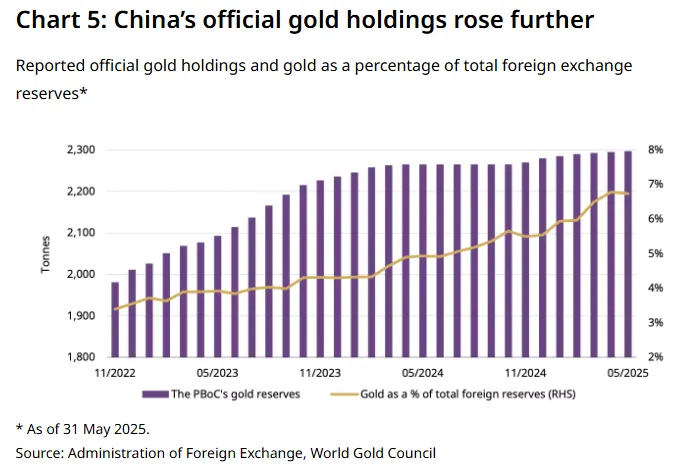
In a trend that signifies the growing allure of gold, central banks have been amassing over 1,000 tonnes annually over the last three years, a stark increase from the average of 400-500 tonnes in the prior decade. The People’s Bank of China (PBoC) exemplifies this trend, with consecutive gold purchases for seven months, augmenting its reserves by 1.9 tonnes in May alone. China’s total gold reserves now stand at 2,296 tonnes, constituting 6.7% of its foreign exchange reserves, as the nation seeks to diversify its reserve assets.
Despite the promising long-term outlook for gold, the short-term prognosis signals the potential for a deeper correction. The resolute $3,500 per ounce threshold poses challenges, increasing the likelihood of a reversion to the $3,000 mark, and potentially, to previous all-time highs around $2,800 per ounce. This speculative bubble has so far avoided a significant pullback, but prevailing market conditions suggest that a course correction could be imminent.
The ongoing volatility, particularly with the evolving geopolitical landscape in the Middle East and forthcoming economic data releases and Federal Reserve projections, suggests a tumultuous path ahead for gold prices. This week, as the market digests the latest US short-term interest rate futures alongside the Federal Open Market Committee’s (FOMC) meeting outcome, gold’s positioning could witness substantial shifts.
Technical analysis indicates that gold is grappling to sustain above the $3,400 mark, with recent declines from its Sunday evening peak around $3,450. Indicators, such as the period 14 RSI crossing below the neutral 50 level, hint at a potential momentum shift in the market. The Fibonacci retracement tool points towards the $3,353 mark as a pivotal area for potential bullish interest, offering a compelling risk-to-reward scenario for investors.
However, the FOMC meeting and the intensifying Israel-Iran conflict, now at a critical juncture, warrant close monitoring, given their potential to impact gold prices significantly.
In essence, while gold’s intrinsic appeal as a safe haven remains undiminished through global crises and economic fluctuations, market dynamics and geopolitical developments continue to shape its journey. As we navigate through these turbulent times, the allure of gold, backed by the strategic maneuvers of central banks and investors alike, endures as a testament to its timeless value and stability in an ever-changing world.
