In the arena of global finance, the perennial ebb and flow of commodities and currencies often narrates tales of geopolitical tremors, economic policies, and their consequent reverberations across markets. A quintessential embodiment of this dynamic is gold, historically revered as the ultimate safe-haven asset. This week, however, an intriguing shift has been observed that calls into question gold’s steadfast role amidst escalating geopolitical tensions, particularly those brewing between Iran and Israel, and the potentially burgeoning involvement of the United States.
As of late, the longstanding conflict between Iran and Israel has intensified, ringing alarm bells of a possible broader regional conflict, especially with the United States’ poised on the precipice of deeper involvement. Such a scenario generally triggers a flight to safety among investors, traditionally benefiting gold. Yet, the expected surge in gold’s allure seems to have been conspicuously absent. Despite the mounting tensions, gold has not only failed to rally but has witnessed a notable decline, suggesting a dilution of its perceived safe-haven appeal.
Conversely, the US dollar, another bastion of safety in times of geopolitical unease, has experienced a notable upswing. This revival, driven by a surge in short-covering, underscores the greenback’s enduring appeal as a safe haven. This dynamic has further compounded the pressure on gold prices, particularly as the potential escalation in the Middle East looms large.
The anticipation of US military involvement has not only stoked fears of a wider regional conflagration but also spotlighted the fragile peace in areas still reeling from the aftereffects of the Gaza conflict. This geopolitical chessboard has altered the strategic calculus for investors, compelling them to recalibrate their positions in gold and the US dollar.
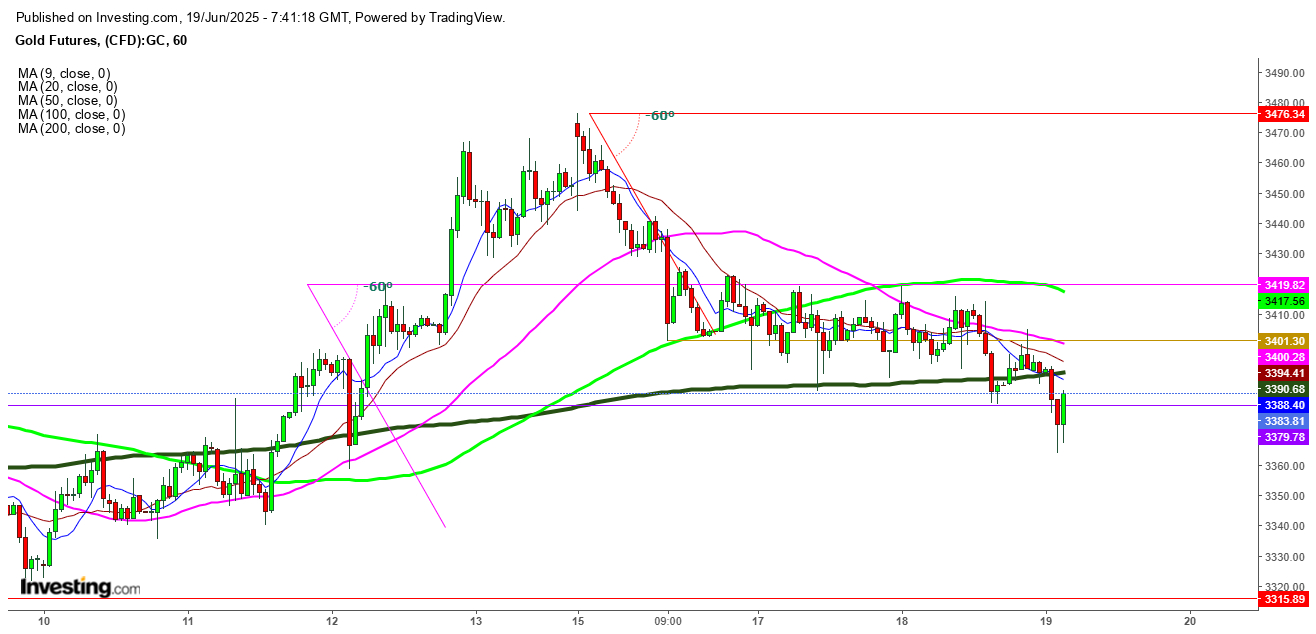
Gold’s journey through the week has been less than lustrous. Opening at a high of $3476, it soon embarked on a downtrend that saw it oscillating within a narrow band between $3419 and $3379. A concerted push beyond these boundaries remained elusive, culminating in a decisive break below the lower threshold on Thursday, with spot prices lingering around $3373.
From a technical vantage point, the analysis becomes even more pointed. On an hourly chart, gold futures have breached a critical support line – the 200-day moving average (DMA) at $3390, after witnessing what technical analysts term a ‘bearish crossover’, an event characterised by the 9 DMA slicing through the 200 DMA. This occurrence, coupled with the 20 DMA and the 50 DMA sliding below the 100 DMA, heralds a potential sell-off, with the trend likely extending into the following days unless gold can sustain above the immediate support pegged at $3334.
Zooming out to a daily chart presents a marginally different picture but with the same undercurrents of bearishness. Gold futures are teetering on the brink of the 20 DMA at $3371, a fall below which could fast-track them towards the 50 DMA at $3326. A breach here might precipitate a slide towards the 100 DMA at $3147, reflecting a significant erosion in gold’s safe-haven appeal in the face of a robust US dollar.
Yet, the market is a creature of possibilities. Any resurgence in gold prices will inevitably encounter a formidable resistance at $3419, a threshold fortified by the pronounced presence of bearish sentiment. This resistance isn’t merely a technical barrier but also a reflection of the broader geopolitical anxieties, particularly the Iran-Israel conflict. The gravity of this situation cannot be overstated, as escalation carries the potential for catastrophic outcomes, given the widespread nuclear capabilities.
In such precarious times, the prospect of a large-scale war serves as a deterrent, fostering a collective aspiration amongst global leaders for a ceasefire, a sentiment further buttressed by the existing global tensions, including trade wars exacerbated by recent US tariff policies. The overarching narrative underscores a world at a crossroads, faced with the daunting challenge of navigating through an increasingly volatile geopolitical landscape.
In conclusion, while the immediate outlook for gold appears subdued amidst these complex geopolitical and economic dynamics, it is crucial to remember that the market is inherently unpredictable. Investors are thus counselled to tread with caution, bearing in mind that today’s analysis might be tomorrow’s footnote in the ever-unfolding saga of global finance.
Disclaimer: This analysis is provided as insights based on current observations and should not be considered financial advice. Investors are advised to conduct their own research or consult a financial advisor before making investment decisions in the gold market.