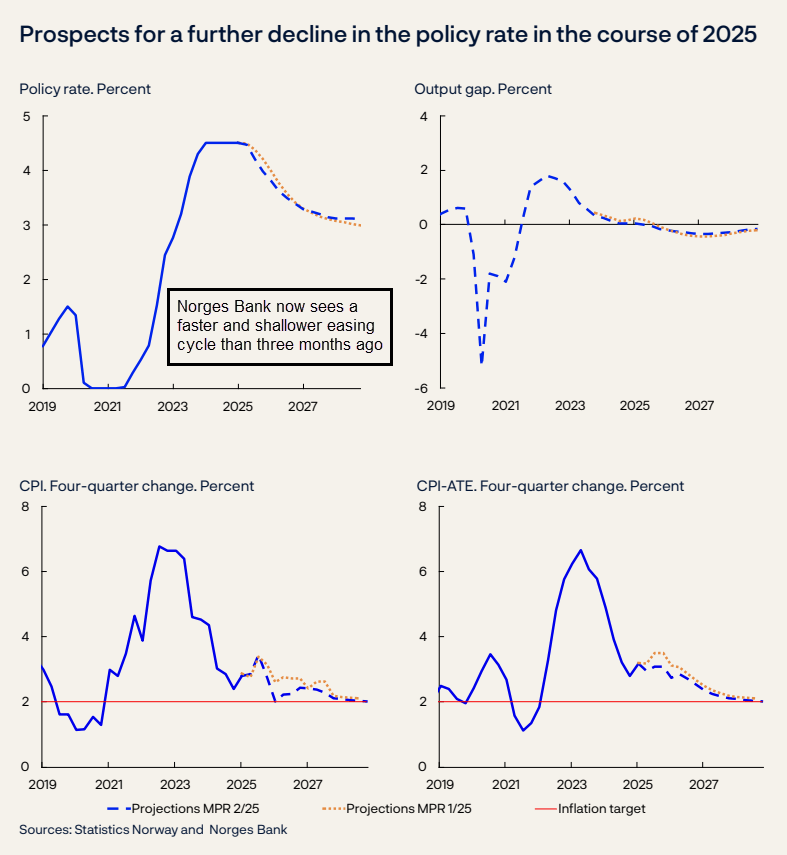
In a move that startled financial markets globally, the central bank of Norway, Norges Bank, announced an unexpected reduction in its sight deposit rate, marking a significant shift in its monetary policy stance for the first time in half a decade. This decision saw the Norwegian krone experience a swift but brief depreciation, highlighting the complex interplay of interest rates, geopolitical dynamics, and global risk sentiment that currently governs currency valuations, particularly in the case of the krone.
A Closer Look at Norges Bank’s Decision
On an ordinary Thursday, markets were caught off guard as Norges Bank reduced the key policy rate by 25 basis points to 4.25%, a surprising move not only because of its timing but also as it reversed the prevailing trend of rate increases observed in the past five years. This adjustment was earlier than the central bank had previously indicated, defying the predictions of many economists and analysts who had been closely monitoring the Scandinavian economy.
This rate cut reflects a nuanced shift towards a more accommodative monetary policy approach by Norges Bank, which now anticipates a shallower trajectory of easing over the coming years. Despite the unexpected timing, the adjusted forecast envisages the policy rate eventually stabilizing at 3% by the end of 2028, a projection slightly more optimistic than earlier assessments made in March. Such adjustments are predicated on recent economic indicators suggesting softer inflationary pressures and a promising outlook for growth, with the 2% inflation target appearing increasingly attainable. However, Norges Bank has maintained a cautious tone, stipulating that the planned easing cycle could be curtailed should wage and price pressures not abate as anticipated.
Impact on USD/NOK Trading Dynamics
Following the announcement, the immediate market reaction was characterized by a notable depreciation of the Norwegian krone against the US dollar, alongside a decline in bond yields as traders rapidly recalibrated their expectations for Norway’s monetary policy trajectory. The adjustments in interest rate differentials, especially considering the Federal Reserve’s stance, momentarily favoured the US dollar, prompting a reevaluation of USD/NOK positions among currency traders.
However, this currency pair’s fate is not solely in the hands of monetary policymakers. Over the recent period, USD/NOK has evolved as a gauge for geopolitical tensions, particularly those affecting global energy markets, given Norway’s status as a significant oil exporter. Fluctuations in Brent crude prices and shifts in investor risk appetite, often influenced by developments in the Middle East, have played a pivotal role in steering the krone’s valuation.
Norway in the Geopolitical Context
The broader geopolitical landscape, including ongoing uncertainties in the Middle East, contributes to the volatility of energy prices and, by extension, currencies closely tied to the oil market. As tensions escalate or de-escalate, currencies like the Norwegian krone are directly impacted owing to the country’s economic dependence on petroleum exports.
In the past weeks, USD/NOK has mirrored the volatility in crude oil markets while displaying an inverse relationship with risk-on assets such as S&P 500 futures. This behaviour underscores the krone’s sensitivity to changes in global risk sentiment, attributing to its characteristic swings in reaction to geopolitical news flows. Despite these fluctuations, key technical indicators signal a prevailing downtrend for USD/NOK, suggesting a market disposition inclined towards selling on rallies rather than buying on dips.
Looking Ahead
As traders and investors process Norges Bank’s recent policy maneuver, the overarching question remains how geopolitical developments and future central bank actions across the globe will steer the USD/NOK pair. Given the complex entanglement of interest rate decisions, oil price trajectories, and geopolitical uncertainties, market participants are advised to stay attuned to a broad spectrum of signals that could impact the currency’s direction in the coming months.
In conclusion, while Norges Bank’s surprising decision to lower interest rates has momentarily shifted market dynamics, a confluence of global factors will continue to play a critical role in shaping the USD/NOK currency pair’s trajectory. Investors and traders alike will need to carefully navigate this intricate landscape, balancing economic fundamentals with the unpredictable nature of geopolitical events and their impact on global financial markets.