



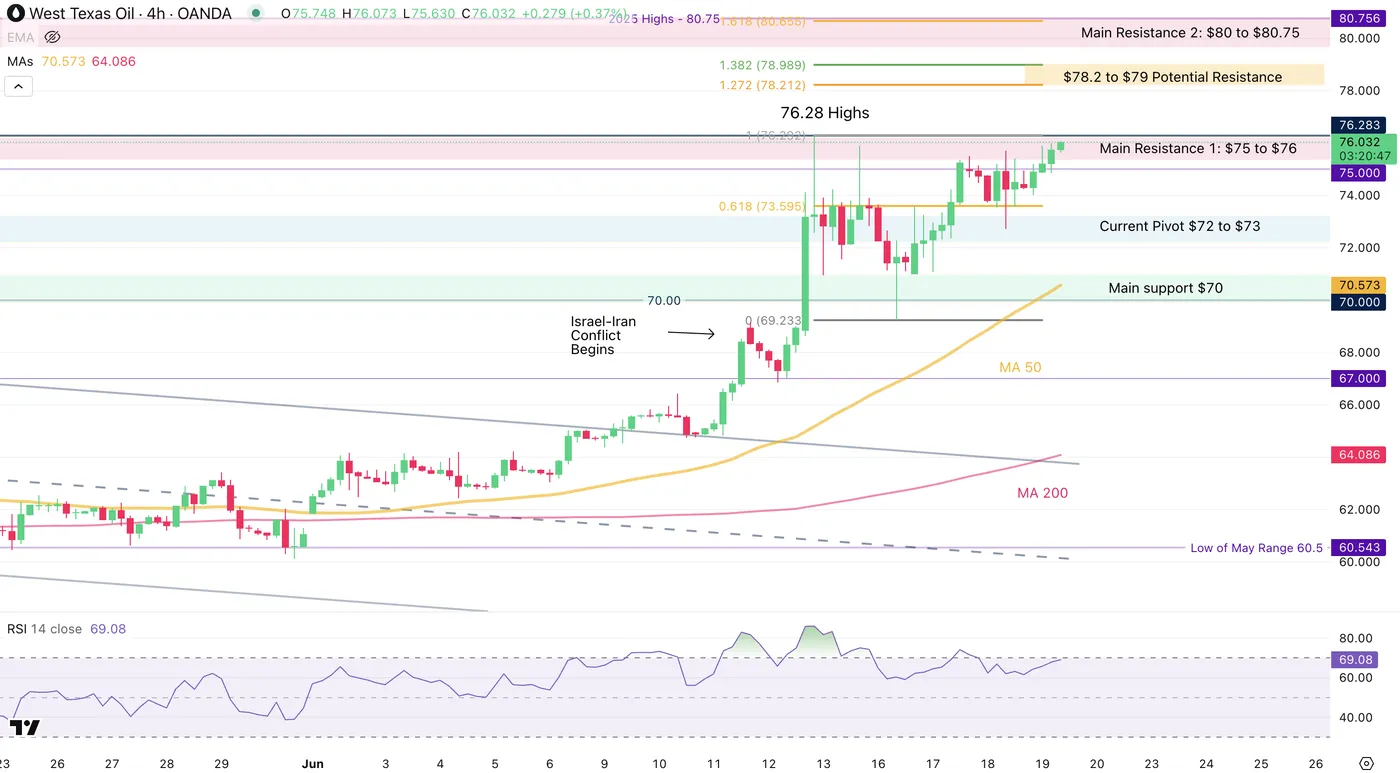
On the previous Thursday, an exceptional surge was observed in the oil market as prices leapt from a starting point of $67 to peak at a close of $76.28 by the session’s end. However, this momentum showed signs of faltering shortly thereafter. Since that time, the market has been awash with continuous updates, painting a picture of escalating conflict as hundreds of ballistic missiles have been met with retaliatory air strikes.
Such geopolitical tensions initially prompted an adjustment in commodities, including oil. Traders, responding to the unfolding developments, started to build up long positions. However, this led to widespread profit-taking, which in turn prevented oil prices from re-achieving those recent peaks—until a resurgence was observed just the day before yesterday.
As the situation continues to unfold, there’s increasing chatter around the possibility of U.S. intervention in the conflict, anticipated to unfold within the coming days. Should this come to pass, it stands to significantly elevate the geopolitical stakes, not least because there’s the potential for other nations to become implicated in the conflict. While currently deemed a remote possibility, the likelihood of this scenario appears to be on an upward trajectory.
Amidst these developments, while U.S. markets observed a closure in recognition of Juneteenth, index futures continued to be traded up until 1:30 PM ET, revealing a downward trend driven by a cautious sentiment. This cautiousness was further mirrored across European equities that also experienced a downturn.
In the background of these unfolding events, oil markets have been characterised by a noticeable volatility. This was evident in yesterday’s trading behaviour which showed marked price fluctuations, with oil prices oscillating between $72 and $75.
Turning our focus to the analysis of intra-day charts, it becomes crucial to identify potential areas of interest within the technical landscape. These could serve as key indicators for directional trades or strategic hedging positions.
Intra-Day Analysis of US Oil
When examining the 4-hour WTI Oil chart, one notes the ongoing phase of consolidation near the recent peak prices, accompanied by an RSI momentum that remains squarely within overbought territory. The rapid ascent in prices has resulted in a significant gap above key moving averages, indicating a bullish sentiment.
With the backdrop of conflict-related news persisting, there’s an expectation for a tightening supply, especially concerning Iran, propelling oil prices to remain at elevated levels. Any further intensification of the regional conflict would likely amplify this trend further.
Conversely, signals indicating any de-escalation in tensions could potentially temper this dynamic, although such an outlook remains far from immediate consideration.
In the event of a breakout, the application of Fibonacci extensions demarcates the next potential resistance zone, falling between $78.20 and $79.00.
Shifting attention to the 1-hour WTI Oil chart, a noteworthy bounce off the $72 mark signals this as a pivotal zone now acting as a support level. Following the FOMC rate decision, attempts to breach below this support were thwarted, paving the way for a potential upward mobility toward the primary resistance zone identified between $75 and $76.
The momentum observed on the 1-hour chart suggests a trend towards a more gradual and sustainable uptrend, in contrast to the more pronounced momentum noted on the 4-hour chart.
Importance is also accorded to the 1-hour 50-period moving average, which may function as a dynamic support level. A breach below this average could signify a resurgence in selling pressure, whereas a bounce from this level may solidify the stance of the buyers.
For shorter term observations, the 15-minute charts corroborate a bullish consolidation narrative, with price actions underlining an overnight recovery just at the $75 mark, situating itself squarely within the current resistance zone. Here, the 50-period moving average emerges yet again as a crucial metric to watch.
In the scenario of an upward breakout, Fibonacci extensions offer insight into potential short-term objectives, hovering around the $77.50 mark. Conversely, should an attempted breakout falter, leading to a subsequent rejection, it’s likely we’d witness a retracement towards the $72–$73 band, which has transitioned to a key support role from its prior stance as resistance.
In navigating these turbulent markets, traders are advised to proceed with caution and discernment.
Reflecting upon the evolving situation, it’s clear that geopolitical events continue to cast a long shadow over the oil markets, influencing price dynamics and trader sentiment. The interplay between supply concerns, geopolitical risks, and market speculation necessitates a vigilant approach to trading, underpinned by a thorough analysis of technical indicators and market trends.
