



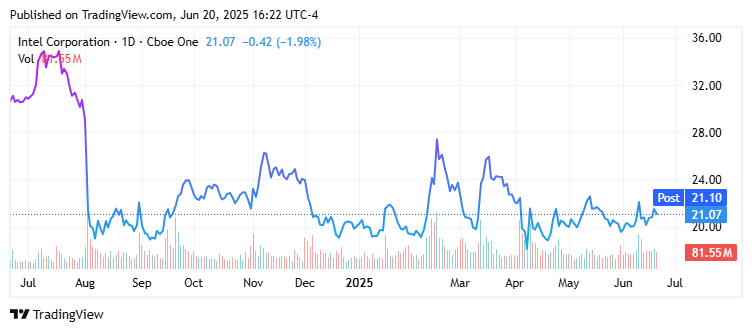
In recent times, a notable shift in the trading dynamics of Intel Corporation, a behemoth in the semiconductor industry, has captured the market’s attention. The company’s stocks have surged in value, illustrated remarkably on June 18 when they soared to an intraday zenith of $21.58, eventually settling at $21.49 by the close of trading. This surge, representing an uplift of over 3% within a single day, contrasts starkly with the previous week’s erratic performance, hinting at a changing tide in market perception—from widespread uncertainty towards a more measured and cautiously optimistic outlook.
The root of this burgeoning confidence seems to be Intel’s succession of strategic manoeuvres, accompanied by favourable media coverage. Taken in their entirety, these actions radiate signals that Intel’s transformation journey, under the stewardship of CEO Lip-Bu Tan, is progressing into a more assertive and action-oriented phase. Events from the recent past conspicuously signal a pivot from mere strategic formulation to bold and comprehensive execution across multiple fronts, offering stakeholders a clearer lens through which to assess the company’s future direction.
Intel Targets the AI Market with Competitive Pricing
A decisive move in this direction is Intel’s aggressive posture in the highly competitive Artificial Intelligence (AI) market. The company made waves in early June with the launch of its Gaudi 3 AI accelerator kit, encompassing eight formidable accelerators, priced at approximately $125,000. This pricing strategy is audaciously competitive, allegedly undercutting equivalent offerings from its rival NVIDIA by potentially more than 50%. Beyond merely releasing another AI chip into the market, this strategic pricing positions the Gaudi 3 as a powerful vehicle for market disruption, directly targeting the burgeoning data center AI sector.
For investors, this bold pricing strategy sparkles with potential as a catalyst for growth within Intel’s Data Center and AI (DCAI) segment. In a marketplace where the financial outlay for AI computing is a paramount concern, Intel’s introduction of a cost-effective yet high-performing alternative could significantly sway large enterprises and cloud customers to reconsider their hardware allegiances.
Despite this potential market shake-up, it’s important to remember NVIDIA’s entrenched position courtesy of its mature CUDA software platform, which offers developers a robust environment for AI application development. This creates a formidable moat around NVIDIA, laden with high switching costs. Nevertheless, Intel’s competitive pricing strategy is a pragmatic and necessary opening gambit in enticing customers to explore alternatives.
Intel’s Strategic Overhaul: A Blend of Innovation and Efficiency
However, the excitement surrounding Intel’s new product offerings should not eclipse another critical area of strategic development: the company’s comprehensive internal restructuring. This dual-faceted strategy not only seeks to refine Intel’s corporate structure but also to enhance its workforce capability.
In sync with this objective, reports of potential discussions to offload its Networking and Edge (NEX) business unit have surfaced, with speculated valuations ranging between $10 billion to $12 billion. Such a divestiture could furnish Intel with a substantial liquidity injection.
Aligning with these structural adjustments is Intel’s emphatic focus on harnessing top-tier engineering talent, evidenced by its recent acquisition of senior engineering leaders from tech giants like Apple and Google. This initiative signifies Intel’s commitment to reinstating an engineering-centric corporate culture. Complementing this talent infusion is a planned downsizing of the factory workforce, projected at up to 20%, underscoring a rigorous cost management strategy to reallocate resources towards innovation and growth.
The Dawn of a Decisive Era
The flurry of activity in the past week may appear as isolated spurts of positive news from a company striving to regain its footing; however, a closer inspection reveals these developments as integral elements of a rejuvenated and accelerated strategic push. Intel’s assertive moves on product pricing, talent acquisition, and portfolio optimisation collectively manifest the tangible execution of strategy that stakeholders have long awaited.
As Intel boldly manoeuvres to fortify its competitive stance through pricing, talent innovation, and focused streamlining, the path ahead is undeniably fraught with challenges. Yet, this transition into a phase of decisive action serves to mitigate the perceived risks surrounding the company’s operational execution. The recent uptick in share price can arguably be interpreted as a logical market response, with investors increasingly confident in the likelihood of Intel’s successful transformation.
This pivotal moment in Intel’s journey underscores a broader narrative within the tech industry: the perpetual quest for innovation, efficiency, and strategic agility. As the company navigates through these transformative times, its actions paint a vivid picture of a legacy firm’s relentless pursuit to adapt and thrive amidst rapidly evolving market dynamics.
