



In the dynamic world of cryptocurrency, Coinbase has positioned itself as a pivotal player, underscored by its robust crypto financial infrastructure. Now responsible for the safeguarding of assets surpassing $310 billion, Coinbase has remarkably expanded its services to cater to an extensive client base. This includes over 110 million users and numerous institutions scattered across more than 100 nations. As the company evolves, its financial narrative, particularly in the first quarter of 2025, illustrates a commendable strategic pivot. With a revenue of $1.6 billion reported in this period, there’s clear evidence of a shift towards generating stable, recurring income, primarily through institutional custody and staking services. This development signifies a complementary diversification from its traditional trading business.
At the heart of this transformation is Coinbase’s conscious effort to diminish its reliance on the erratic fees derived from retail transactions. The strategy has proven to be effective, significantly altering its revenue composition by mid-2025. The introduction of spot ETFs in 2024 marked a significant milestone, catapulting Coinbase Custody into the limelight as a premier custodial service for notable institutional investors such as BlackRock and Franklin Templeton. This move not only cemented its leadership position in the market but also ushered in a stable stream of custody fee revenue. Enhancements in staking services, especially for Ethereum, have further solidified the company’s revenue base from subscriptions and services. The role of USDC stablecoin operations in interest income remains critical, yet it now integrates into a larger, diversified portfolio of recurring revenue streams. This approach has been instrumental in buffering the company against the fluctuations in trading volume.
Coinbase’s operational agility is evident in its pioneering efforts to enable round-the-clock trading capabilities for Bitcoin and Ethereum futures in the United States. This initiative sets Coinbase apart from competitors such as the CME Group, which operates on a more traditional 23/5 trading calendar. The adoption of a 24/7 trading framework speaks to Coinbase’s commitment to innovation, despite the substantial capital outlay required for maintaining redundant matching engine infrastructures to ensure continuous operational integrity and reliability.
Examining Coinbase’s financial performance offers insights into the intricate relationship between its fortunes and the broader cryptocurrency market conditions. The year 2024 saw a revenue surge to $6.6 billion, a 111% increase, albeit shy of the 2021 pinnacle of $7.4 billion. This growth spurt was largely fuelled by heightened trading activities and appreciation in cryptocurrency asset values. Monthly Transacting Users (MTUs) soared by 14%, indicating a robust userbase of 8.4 million by the close of 2024.
Transaction fees continued to dominate the revenue streams in 2024, accounting for 61% of the total revenue, an uptick from the previous year. The bulk of this revenue, approximately 86%, was sourced from retail users, underscoring the persistent dependency on this segment. Notwithstanding, the subscription and services revenue segment witnessed a remarkable 64% growth, reaching $2.3 billion, showcasing a gradual yet significant shift towards less volatile income sources.
The stellar performance in the fourth quarter of 2024, with a 138% year-over-year revenue increase to $2.27 billion, was a notable highlight. This period also saw an exponential rise in operating income, buoyed by a disciplined approach to cost management. The adjustment in operational expenses indicates a potential for significant leverage as revenues edge towards the $6 billion mark. Wrapping up 2024, Coinbase boasted a formidable liquidity reserve of $9.3 billion, reinforcing its financial resilience.
In the competitive scape of over 300 cryptocurrency exchange platforms, Coinbase has secured approximately 10% of the global trading volume share by late 2024, facilitating $1.2 trillion in trading volume. Despite stiff competition from entities like Binance, Kraken, Gemini, and Robinhood, Coinbase distinguishes itself in the U.S. market through rigorous compliance with Anti-Money Laundering (AML) and Know Your Customer (KYC) regulations. This strategic regulatory alignment affords Coinbase a competitive edge, especially considering the potential influx of traditional financial entities into the cryptocurrency market pending regulatory clarifications.
The company’s foresight in earmarking custodial and staking services, alongside other institutional offerings, anchors its long-term aspirations for revenue stability and growth. As the cryptocurrency landscape matures and institutional adoption widens, Coinbase’s early investments in high-margin, recurring revenue domains signal a sustainable competitive vantage.
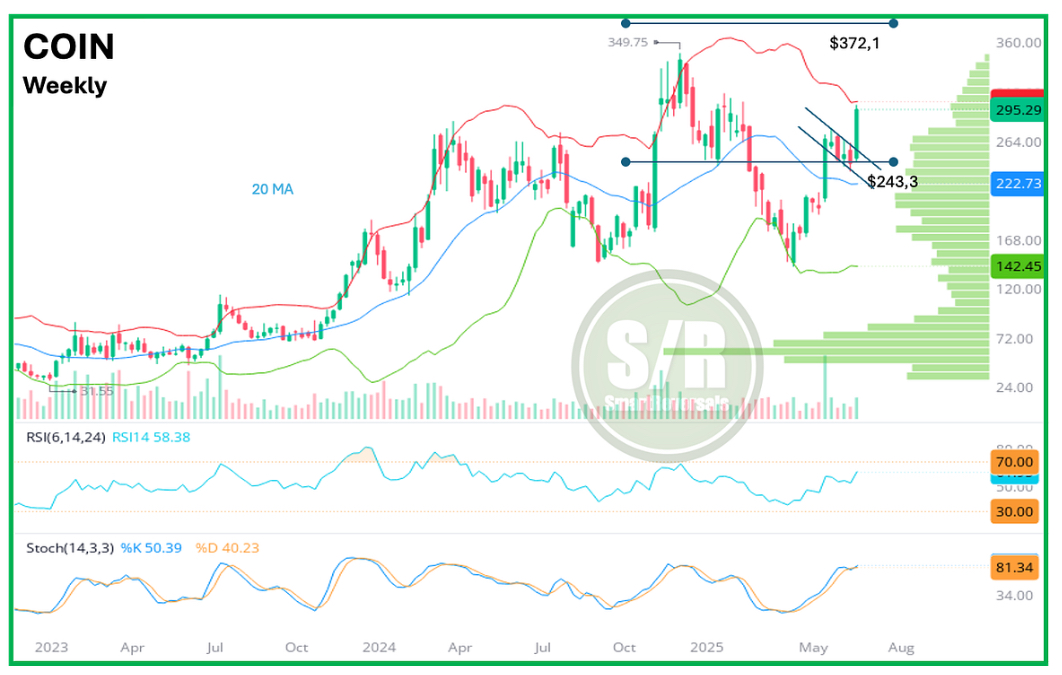
Turning to technical analysis, recent trends suggest a bullish momentum, characterized by a ‘bull-flag’ pattern. Despite nudging against the higher Bollinger band, there’s anticipation for upward price adjustments. A consolidation phase seems likely, yet the $350 target zone for 2025 remains within reach, buoyed by potential consolidations. Critical to note is the current market sentiment, where the Relative Strength Index (RSI) indicators suggest an absence of overvaluation, thus staving off immediate concerns of a correction.
As the narrative around Coinbase unfolds, it’s paramount to approach such market analysis with discernment, recognizing the inherent risks and volatility of cryptocurrency investments. This analysis is not intended as investment advice but rather a snapshot of Coinbase’s strategic journey and market positioning within the evolving digital asset landscape.
