





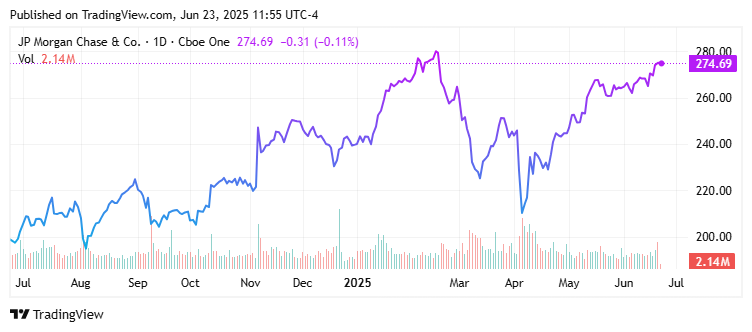
Understanding the financial behemoth that is JPMorgan Chase & Co, the preeminent banking institution in the United States, is no small task. With a balance sheet that exceeds $4 trillion, the scale of its operations and influence is truly monumental. In a financial landscape characterised by persistent inflation and global uncertainties, investors are on the hunt for safe havens. They seek investment opportunities that not only stand tall in terms of size but also demonstrate unwavering stability and hold a clear vision for the future.
Let’s delve deeper into the essence of JPMorgan Chase & Co. At its core, the bank’s strategy is centred around a robust plan of action, crafting a financial citadel engineered not just to endure the challenges of today but to pioneer and innovate for tomorrow.
A Financial Bastion in Practice
For numerous years, the leadership at JPMorgan has advocated for what is known as a fortress balance sheet ideology. This ideology is underpinned by one principle: to maintain capital reserves significantly above the minimum requirements set by regulatory bodies. A critical measure of this is the Common Equity Tier 1 (CET1) ratio—a barometer of a bank’s capability to absorb unforeseen financial disturbances. A formidable CET1 ratio is indicative of a bank’s strength and resilience.
This financial prowess was put to the test during the regional banking crisis in 2023, a tumultuous period that saw the finance sector bedevilled by instability. Amidst this chaos, JPMorgan stood like a beacon of stability, managing to take under its wing First Republic Bank. This acquisition not only quelled market anxieties but also allowed JPMorgan to strategically enhance its wealth management operations, showcasing its capability to leverage its financial clout for strategic growth.
Moreover, the fortress balance sheet model stands JPMorgan in good stead for the forthcoming Basel III Endgame capital regulations set to be introduced by U.S. regulators. With indications that these rules may be less restrictive than initially presumed, JPMorgan’s capital manoeuvrability could see a significant uptick, potentially paving the way for augmented stock buybacks or dividend hikes—both of which spell good news for shareholders.
An Integral Player Across the Economic Spectrum
JPMorgan’s resilience is rooted not merely in its substantial cash reserves but also in its diversified business model. The bank operates as a veritable economic juggernaut across four major segments, thus ensuring balanced and stable outcomes.
- Consumer & Community Banking (CCB): This foundational pillar of JPMorgan amasses a vast and stable base of low-cost deposits through millions of customer accounts.
- Corporate & Investment Bank (CIB): As a frontrunner in investment banking, this segment thrives on profits generated from corporate ventures, encompassing mergers, acquisitions, and capital raising initiatives.
- Commercial Banking (CB): Tailored to meet the needs of mid-sized businesses—the backbone of the American economy—this division provides critical lending and financial services.
- Asset & Wealth Management (AWM): This segment is instrumental in managing trillions in client assets, generating steady, fee-based revenues, thereby cushioning against market volatility.
This diversification ensures that any slowdown in one segment can potentially be counterbalanced by strength in another, thus leading to predictable and steady earnings that appeal to long-term investors.
Pioneering Tomorrow’s Banking Landscape
While its formidable size provides a defensive shield, JPMorgan is equally committed to offensive strategies that secure its future. The bank invests billions annually in technology, powering advancements in artificial intelligence (AI), data analytics, and cybersecurity. These investments are crafting a significant competitive edge for the future.
A quintessential example of JPMorgan’s pioneering spirit is the pilot of its “JPMD” deposit token. Utilizing blockchain technology, this project endeavours to create a regulated digital dollar, facilitating instant and secure transactions for large clients. This initiative is a testament to JPMorgan’s commitment to bridging the gap between traditional banking and the expediency of digital finance.
Considerations for Investors
No investment comes without risks, and a thorough understanding of JPMorgan necessitates a contemplation of potential hurdles. The bank’s fortunes are closely intertwined with the broader economy. Special attention should be paid to interest rates; a potential rate cut by the Federal Reserve in 2025 could impact the bank’s Net Interest Income. Regulatory oversight and the competitive landscape are other critical areas to monitor.
A Convincing Argument for a Core Investment
Ultimately, JPMorgan Chase & Co’s robust business model delivers tangible value for its shareholders. The bank has a history of increasing its dividend for 15 consecutive years, underscoring management’s confidence and the firm’s enduring strength. Moreover, with a dividend payout that constitutes just 27.5% of the company’s earnings, there’s ample room for growth.
In terms of valuation, JPMorgan trades at a price-to-earnings ratio of about 13, striking a reasonable balance for a market leader known for consistent profitability. For those looking to build a resilient and growth-oriented portfolio, JPMorgan represents a cornerstone investment, combining proven stability, diverse earnings streams, forward-looking innovation, and a solid commitment to shareholder returns.

