





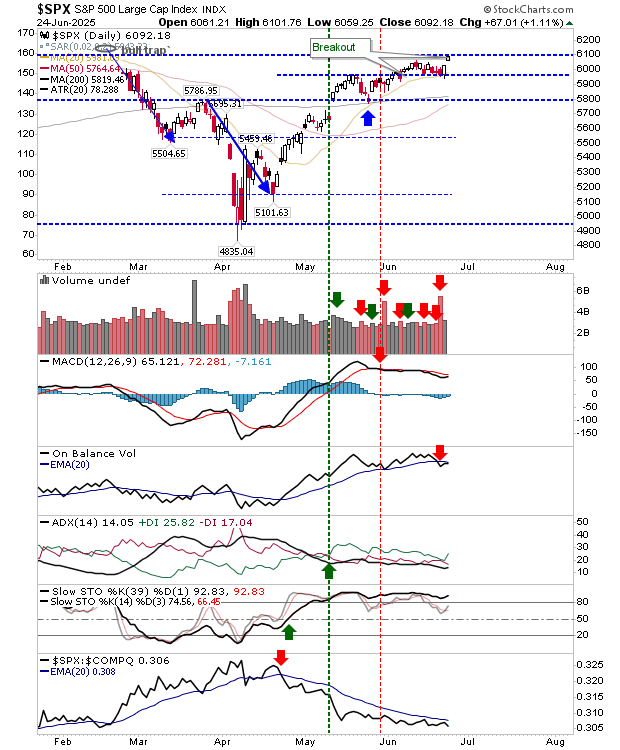
On Monday, financial markets exhibited bullish piercing patterns, a harbinger that was confirmed on Tuesday as markets opened with gaps and closed with considerable strength, surpassing the highs seen in June. This recent rally edged the markets closer to surpassing their all-time highs, highlighting a palpable optimism among investors. What’s particularly noteworthy is the observed market dynamics in response to geopolitical tensions between the US and Iran. Despite potential reasons for concern, the markets’ reaction to the cessation of hostilities was far more vigorous and positive than the selling pressure induced by initial fears of escalation, suggesting a strong underlying desire among traders and investors to push the market higher.
The situation at hand is a testament to the resilience of financial markets and their capacity to navigate through geopolitical uncertainties. The market’s behavior is challenging the so-called ‘bull trap’ that was set in February, suggesting that investors are growing confident about the market’s ability to sustain its upward trajectory. Despite the presence of ‘sell’ signals in the Moving Average Convergence Divergence (MACD) and On-Balance-Volume indicators, which typically suggest caution, the market is hinting at a potential breakout, indicating strong bullish sentiment.
The smaller-cap index, represented here, has also shown commendable performance, challenging its 200-day Moving Average (MA) following the gains made on Tuesday. The emergence of ‘buy’ signals within the positive directional indicator (+DI) and negative directional indicator (-DI), alongside the On-Balance-Volume, underscore the bullish momentum building within these segments of the market. Given the pattern of right-hand base development and the supportive gains observed in corresponding indices, it’s reasonable to anticipate further upward movement.
Furthermore, the technology-heavy index made significant strides, gapping higher, albeit without breaching the all-time highs or overcoming the psychological barrier of 20,000 points. However, the technical indicators, with the exception of the MACD, remain bullish, suggesting that achieving new all-time highs is well within reach.
The backdrop to these market movements involves the earlier tensions between Israel and Iran, a scenario that primed the markets for a significant breakout towards new all-time highs. Contrary to potential expectations, the selling pressure from those looking to capitalize on the geopolitical tension never materialized to a degree that would significantly undermine market support levels. The announcement of a ceasefire acted as a powerful catalyst, propelling the market indices beyond their previous constrained ranges, and setting the stage for what could potentially mark the commencement of a new bull market.
This scenario is illustrative of how geopolitical events and market responses can interact in complex ways, often defying straightforward predictions. The market’s resilience in the face of geopolitical tensions and its ability to seize on optimistic developments, like the announcement of a ceasefire, points to a deeper dynamism within financial markets. This dynamism, fueled by a combination of technical indicators, investor sentiment, and real-world events, drives market trends and creates opportunities for astute investors.
Understanding this interplay requires not just a grasp of the technical aspects, such as chart patterns and indicators like the MACD or On-Balance-Volume but also an awareness of the broader geopolitical and economic context. This includes the capacity to interpret how events like the US-Iran tensions can influence market sentiment and investor behavior.
As we stand on the precipice of potentially new market highs, it’s clear that the financial landscape is ever-shifting, shaped by a myriad of factors that require both vigilance and the capacity to adapt. For investors and market watchers, the current scenario underscores the importance of staying informed, being able to read between the lines of market signals, and understanding the broader context within which these signals occur.
In conclusion, as markets navigate through these intricate dynamics, the unfolding story is not just about numbers or charts; it’s about the confluence of human decisions, geopolitical events, and economic trends. For those willing to delve into this complexity, the rewards can be as enriching as the insights gleaned from the journey itself.

