



The financial markets have recently been captivated by a whirlwind of activity, with the Nasdaq composite index propelling American stock indices to unprecedented heights this past Wednesday, a remarkable accomplishment that brings the spotlight back onto the technology sector.
This exhilarating journey into record-breaking territory has come at a time when economic indicators have presented a mixed bag of results. For instance, the latest inflation figures did not meet the optimistic expectations set by economic forecasters. Inflation clocked in at 2.7% as opposed to the anticipated 2.6%, with month-on-month growth also slightly exceeding expectations at 0.2% against a forecast of 0.15%. Although these discrepancies may seem minor, they represent one of the first instances since Donald Trump assumed the presidency where the market’s expectations have been confounded in such a manner.
Amidst these fluctuations, there has been a steady stream of updates pertaining to the United States’ trade negotiations. A noteworthy development arrived from the White House, downplaying the significance previously attributed to July 9, while Trump has hinted at nearing a comprehensive trade agreement with China. However, the absence of finer details has left market participants hanging in anticipation.
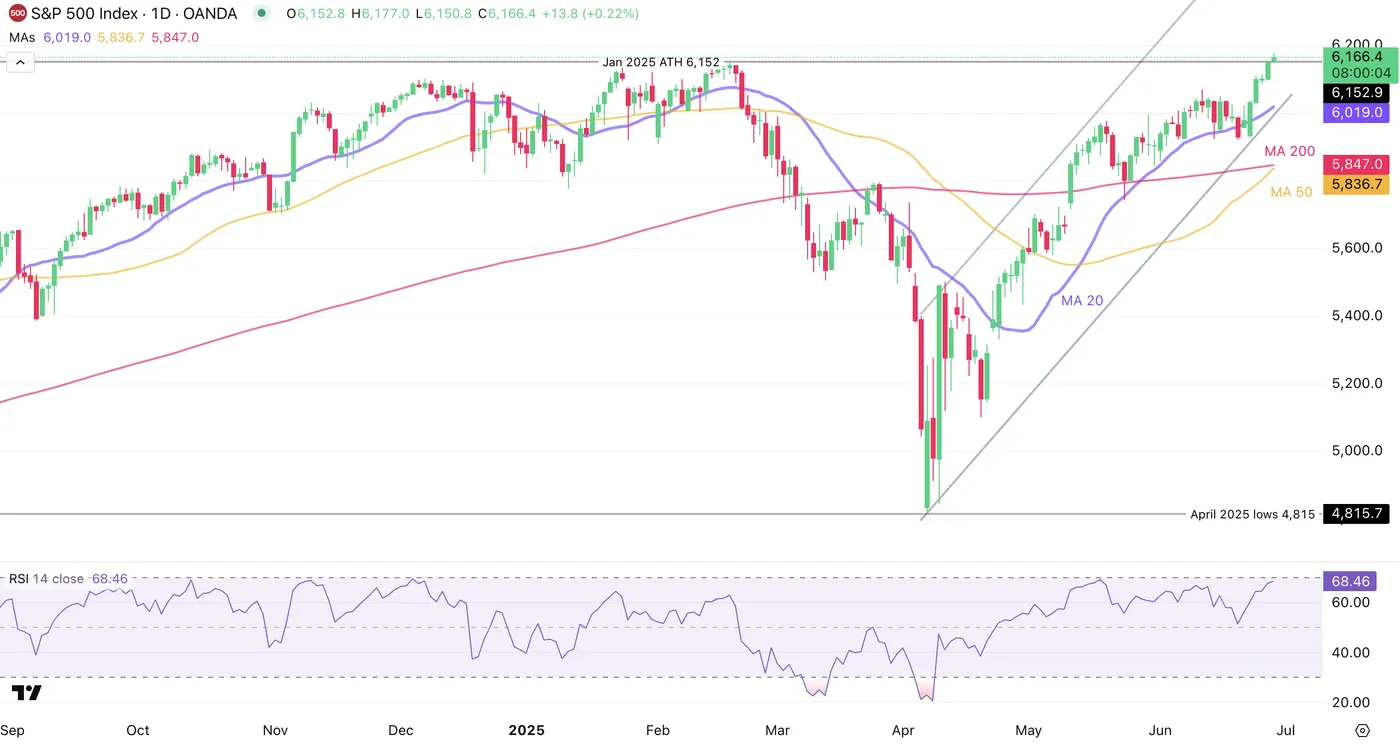
Turning our attention towards the S&P 500, a closer examination of its technical performance offers a fascinating insight into the current state of the equity markets. This year has been characterized by considerable volatility, yet it’s intriguing to observe the market’s evolving response – or lack thereof – to events linked to Trump, particularly as the tension between Israel and Iran recedes from the media spotlight.
A potential “Golden Cross” scenario is on the horizon, with the 50-day moving average poised to cross above the 200-day moving average. This event is traditionally viewed as a bullish indicator, yet continued upward momentum in risk assets may necessitate further reinforcement from robust economic data.
Despite the release of significant economic indicators, the S&P 500’s performance remains steadfast, with only minor fluctuations observed around the January All-Time High (ATH). The critical test of market sentiment will be at the opening bell – will traders demonstrate an appetite for pushing the boundaries of price discovery further?
In the wake of de-escalation and ceasefire efforts in the Middle East, the purchasing activity observed in the markets has been nothing short of astonishing. For the past five years, strategic buying during dips, especially in the context of positive news or the dissipation of negative factors, has proven to be a successful tactic.
Reflecting on the S&P 500’s recent trajectory, we’ve witnessed a significant recovery, with the index surging from a low of 4,800 to the current levels exceeding 6,160. Traders closely monitor the 1-hour 20-period moving average to gauge the market’s momentum, with the Relative Strength Index (RSI) providing additional insights.
Investors eyeing potential entry points should consider several key levels. Resistance is anticipated around the 6,170 mark, with the index having briefly touched 6,177, hinting at the possibility of encountering resistance near 6,200. On the downside, the immediate support level is in the vicinity of 6,150, closely shadowed by additional support at a pivot point of 6,100, and further support identified at the 1-hour moving average (MA) 200 at approximately 6,040.
As trading commences, investors and market participants should navigate the markets with caution. The landscape ahead is filled with both opportunities and challenges, demanding a balanced approach to decision-making.
The backdrop to these developments includes a broad canvas painted with the brushstrokes of global economic trends, geopolitical dynamics, and the intricate dance between policy formulation and market reactions. As such, those monitoring these developments—whether seasoned investors or newcomers to the financial markets—must equip themselves with a nuanced understanding of these forces at play to make informed decisions in an ever-evolving economic environment.
In essence, the interplay between these dynamics shapes not only the immediate future of the stock markets but also frames the broader dialogue concerning economic resilience, innovation, and the path towards sustainable growth.
