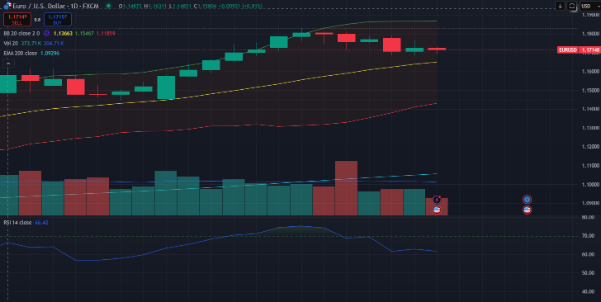
Amidst an environment where the exchange rate hovers around 1.20, concerns have been raised about Europe’s economic stability. Recent developments have seen the EUR/USD pair climb past $1.175, reaching heights not witnessed since August 2021. This shift followed the unveiling of a US proposal to the European Union regarding a trade agreement, which proposes maintaining a base tariff of 10% while offering exemptions for specific sectors, including aeronautics and alcohol.
However, the United States has yet to clarify potential exemptions for other crucial sectors, such as automobiles, technology, agriculture, and pharmaceuticals, despite requests from the EU. The European Union is seeking a swift preliminary accord with the United States to extend the 10% tariff beyond the original August 1 deadline, as discussions for a long-term agreement persist.
In response to the US tariffs on metals, the European Union has mooted the introduction of retaliatory tariffs on a range of American goods. European officials have also warned of additional countermeasures, which could include export controls and restraints on American firms’ access to public procurement within the EU, should negotiations falter.
From a monetary policy perspective, market participants are anticipating potentially only one more interest rate cut from the European Central Bank (ECB) by year’s end. This comes as the Eurozone’s inflation rate slows to align with the ECB’s target of 2%. According to preliminary estimates by Eurostat, the core inflation rate, which excludes volatile food and energy prices, has also stabilized at 2.3%, suggesting a reduction in overall inflationary pressures. Nevertheless, certain sectors like services and food continue to experience price surges, exerting strain on household budgets across Europe. Interestingly, there exists a significant disparity between official inflation rates and the inflation levels perceived by European consumers, who estimate a stable inflation rate around 3.1%, fostering social discontent and eroding trust in current economic strategies.
On the monetary front, the European Central Bank is exercising prudence. Despite a downward trend in short-term inflation forecasts, the likelihood of a rate reduction in the forthcoming July meeting seems low. The ECB’s cautious approach stems from a desire to prevent an untimely boost in demand that might lead to further inflation, especially with ongoing geopolitical tensions affecting energy markets.
The stabilization of inflation rates within the Eurozone marks a noteworthy milestone, yet this achievement remains precarious and easily swayed by external factors such as volatile energy prices, heavily influenced by geopolitical dynamics. Additionally, this stability alone does not seem adequate to propel economic recovery, given the persistent economic frailties.
As the exchange rate approaches 1.20, it becomes essential to contemplate the possible implications of such an elevated rate. The euro’s appreciation is an increasing cause for concern, with analysts noting that while an exchange rate of up to USD 1.20 is manageable, any substantial appreciation beyond this threshold could exert immense pressure on Europe’s economic framework.
An overly robust euro could penalize exports by diminishing the competitiveness of European businesses on the global stage. This situation adds to the challenges facing the manufacturing sector, already grappling with sub-par performance – for instance, the Purchasing Managers’ Index (PMI) remains below the 50-point mark indicating expansion in several key economies, including Italy and France, signalling contraction phases. Spain, however, presents a semblance of moderate growth.
The current scenario, marked by a weakening dollar and a strengthening euro, is likely to lead to a shift in investment strategies, with increased allocations toward US markets and a corresponding decrease in European assets’ portfolio weight.
In light of these developments, my current investment strategy includes holding long positions in a diverse range of stocks, such as Codexis Inc, Palisade Bio Inc, Ramelius Resources Ltd, AutoZone Inc, Hycroft Mining Holding Corporation, and Intuit Inc. This selection reflects a careful consideration of the current economic landscape and the potential growth opportunities within these varying sectors.