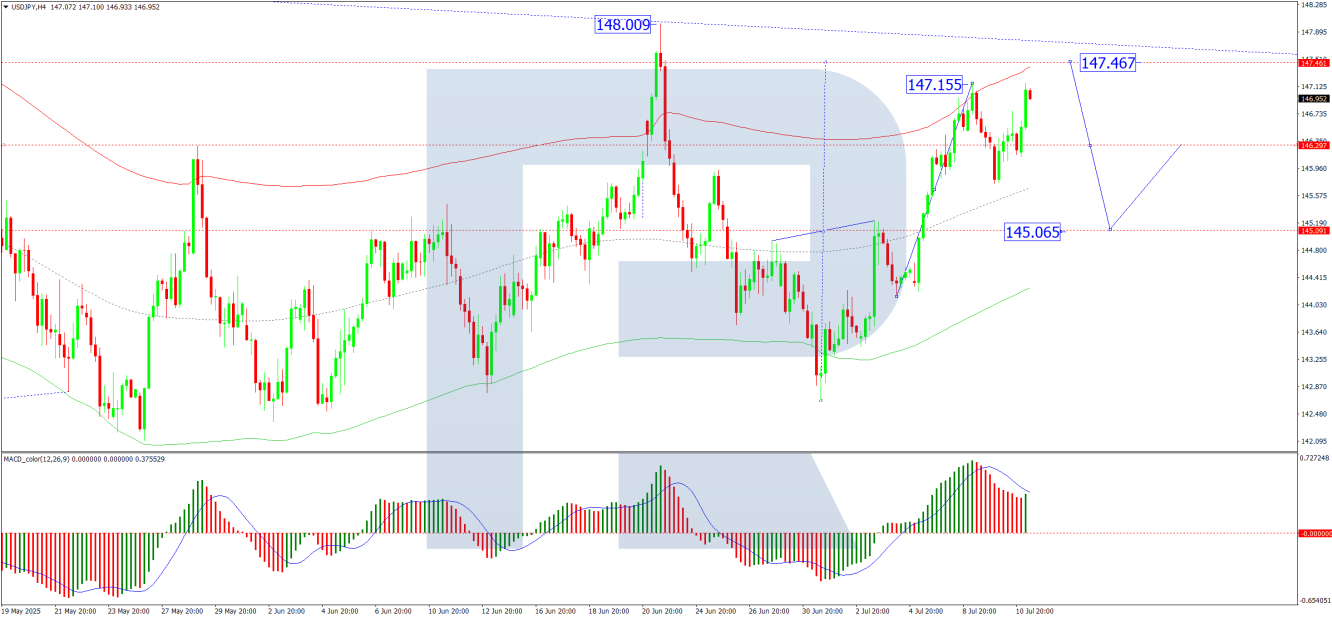
On a notable Friday, there was a significant development in the currency markets as the currency pair involving the US dollar and the Japanese yen experienced a robust upward trajectory, reaching a zenith not observed in the preceding three weeks, with a closing figure of 146.93. This ascent can largely be attributed to the US dollar’s pronounced consolidation, an occurrence that unfolded against a complex backdrop of intensifying uncertainties surrounding global trade practices and policies.
This period has been marked by a flurry of activity and considerable upheaval in international trade, with the US administration, under the leadership of President Donald Trump, taking steps that have sent ripples across the global economic landscape. A striking feature of this tumultuous period has been the announcement of a series of additional tariffs, a move that unequivocally signifies a shift towards a more protectionist trade stance by the United States. Among these measures, the imposition of a 35% tariff on imports from Canada stands out for its potential to significantly alter bilateral trade dynamics. This development, however, is merely a part of a broader spectrum of newly introduced duties, with the administration proposing sweeping tariffs ranging from 15-20% on a wide array of imports from most of its trading partners.
A critical aspect of this evolving situation that merits particular attention is the upsurge in tensions between the United States and Japan. The recent declaration by President Trump to levy a 25% tariff on Japanese goods, effective from the 1st of August, has escalated concerns regarding the future of US-Japan relations. This move has not only intensified bilateral discord but has also prompted a reevaluation of the dependency paradigm that characterizes the Japan-US relationship, encompassing critical sectors such as defence, food security, and energy. In response to these developments, Japanese Prime Minister Shigeru Ishiba has articulated a viewpoint situating these negotiations within the broader framework of a “battle for national interests”. This perspective is underscored by analyses from leading Japanese think tanks, which project a bleak economic outlook indicating that the imposed tariffs might lead to a contraction of 0.8% in Japan’s GDP by the year 2025, further diminishing to a cumulative decline of 1.9% by 2029.
Technical Analysis of the USD/JPY Currency Pair
An examination of the H4 chart reveals that the USD/JPY currency pair has established a consolidation range bound by 145.65 on the lower end and extending to 147.17 on the upper. Market analysts anticipate a short-term reversion to the 145.65 level, an assessment buoyed by the underlying dynamics, which suggest a possible subsequent surge, with an eye on the 147.47 mark at a minimum. This outlook garners support from the prevailing trends suggested by the MACD indicator, where a positive disposition is noted with the signal line positioned firmly above the zero threshold, indicating upward momentum.
Further scrutiny through the lens of the H1 chart delineates a phase of consolidation in the vicinity of 146.41, succeeded by an upward breakout that culminated in the formation of a wave structure peaking at 147.17. Current predictions, reinforced by the trajectories suggested by the Stochastic oscillator – with the signal line prominently positioned at 80 and exhibiting a sharp downward trajectory – point towards an imminent corrective pullback towards 145.65.
Conclusion
In the wake of these observations, the prevalent sentiment among market observers is one of cautious anticipation. The yen’s observable fragility, juxtaposed with the strength showcased by the dollar and the overarching ambiance of trade-related uncertainties, lays the ground for a period characterized by potential volatility in the near term. Market participants are therefore advised to closely monitor the 145.65 level, which emerges as a critical support juncture, whilst remaining cognizant of the plausible extension of the upward momentum towards 147.47.
Thus, as we navigate through these turbulent times, enveloped by a milieu of intricate trade negotiations and unpredictability in currency markets, a nuanced and informed approach remains the cornerstone of successful market engagement.
Disclaimer: The views expressed in this analysis represent those of the author and do not constitute financial advice. The analysis is provided for informational purposes only and does not entail any obligations from the part of RoboForex or the author regarding trading operations that may be conceived based on this analysis. Market participants are urged to conduct their own research and due diligence.