



In the world of financial markets and investments, accurately predicting market movements is akin to searching for a needle in a haystack. Nonetheless, expert analysis and structured approaches can bring us closer to making informed predictions. One such method is the Elliott Wave (EW) Principle, a detailed description of how groups of market participants behave. This principle revolves around the theory that markets move in repetitive cycles, driven by investor psychology manifesting as waves. Let’s delve into how the NASDAQ100 index, a barometer for tech-heavy stock performance, has recently behaved in alignment with the Elliott Wave Principle’s predictions, and how this insight offers a blueprint for understanding and potentially navigating future market movements.
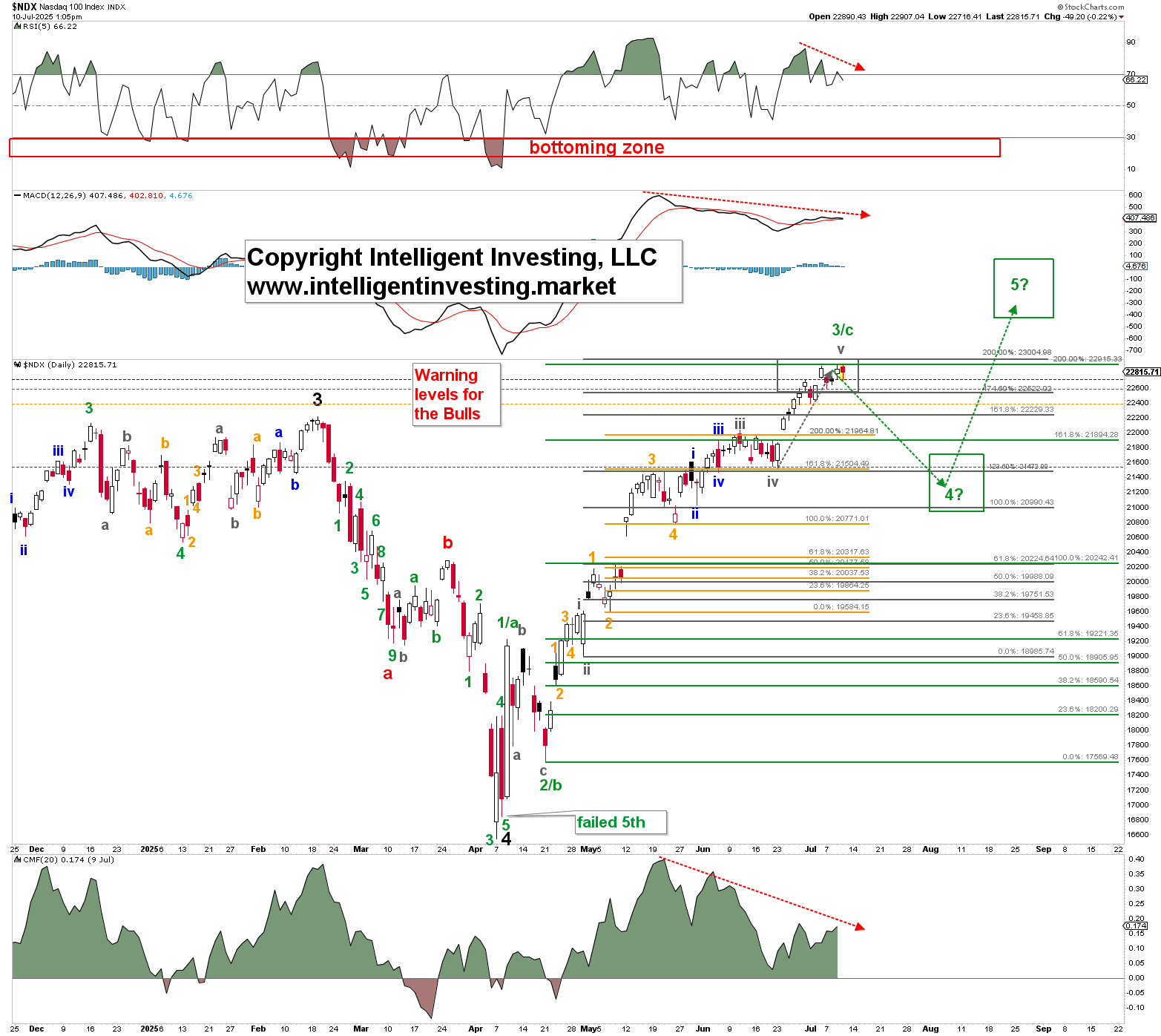
Three weeks prior, an analysis predicated on the Elliott Wave Principle postulated that the NASDAQ100 index was on the cusp of reaching a significant peak. At that juncture, the analysis forecasted an ‘ideal’ top for the index at roughly $22,237, pinpointed as a typical Wave-iii/c target. It was anticipated that following this peak, the index would enter a transitional phase, referred to as the gray Wave-iv, at an ideal point around $20,995, before escalating to a new zenith – the gray Wave-v – projected to reach a 200.0% Fibonacci extension at around $23,095.
As the days unfolded, this forecast bore remarkable resemblance to actual market movements. Specifically, on June 11, the index peaked at $22,041, subsequently bottomed out on June 23 at $21,532, and thereafter surged to a new all-time high (ATH) of $22,915. Thus, the index’s journey closely mirrored the anticipated wave iii, -iv, -v pattern, with deviations from the forecasted targets standing within a remarkably narrow range – 0.88%, 2.55%, and 0.78%, respectively. This extraordinary accuracy reinforces the credibility and utility of the Elliott Wave Principle in understanding and predicting market dynamics.
To ensure traders remained on the advantageous side of the market tide, warning levels for bullish sentiment necessitated adjustments in line with the index’s progression. These levels served as crucial navigational beacons. The first, denoted in blue, signaled initial caution at $22,733. A subsequent gray marker indicated a more pronounced cautionary threshold at $22,587. Following this, an orange alert at $22,386 served as a penultimate warning, with a red marker at $21,532 signaling a shift to an alternative Elliott Wave scenario. Such stratification of warning levels is imperative, offering traders insight into when to adjust their expectations and strategies in light of unfolding market dynamics.
Underpinning successful trading within this framework is a clear understanding of one’s position within the market’s cyclic waves. A trader’s quintessential aim is to pinpoint the most lucrative wave patterns, such as the third wave or C wave. In this context, although the third wave (green W-3/c) was eyeing its culmination, the presence of negative divergences on various technical indicators, coupled with the absence of an unequivocal, price-based signal that the wave had concluded, advised continued market participation.
In summary, while the trajectory of the May 26 and June 23 lows leaves room for speculative extension of the wave pattern, expectations lean towards the imminent conclusion of the green W-3/c wave. The essence of Elliott Wave analysis, fundamentally rooted in observed price action, obviates the need for speculation. Instead, it offers a structured framework for anticipating market movements, enabling traders to navigate the tumultuous seas of the financial markets with greater confidence and foresight.
As we have seen through the lens of the NASDAQ100 index, the application of the Elliott Wave Principle offers a compelling narrative on how markets move, underscored by patterns of investor psychology. This case study not only exemplifies the principle’s predictive potential but also highlights the importance of adaptable strategies in the ever-changing landscape of the stock market. In conclusion, as nascent and seasoned investors alike seek to chart a course through the financial markets, methodologies such as the Elliott Wave Principle stand out as indispensable tools in the arsenal of informed decision-making.
