





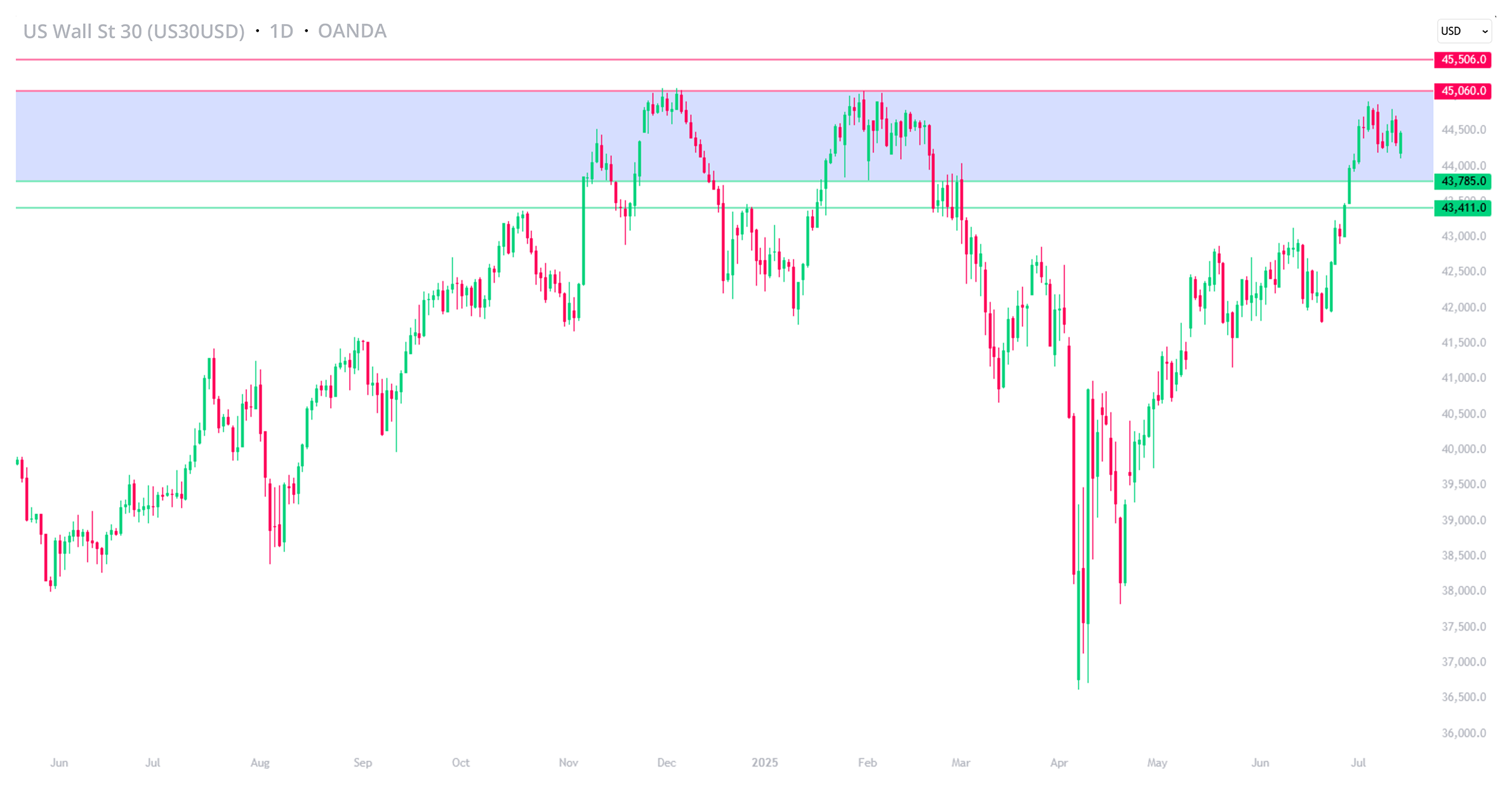
In the ever-dynamic landscape of global financial markets, the Dow Jones Industrial Average (DJIA), one of the most closely watched indices in the United States, showcased a modest uptick of approximately 0.29% as trading concluded on Monday. This upward movement is particularly notable as it found footing at the lower boundary of its prevailing daily trading range, with the index positioning itself around the 44,471 mark.
### Dow Jones Industrial Average: Unpacking the Monday’s Market Movements
The culmination of the previous trading week left investors somewhat disheartened as the DJIA experienced a downturn. However, as the new week commenced, a flicker of resilience was evident in Monday’s session, indicating a phase of consolidation within the market. This phenomenon has sparked a renewed interest among investors, prompting a shift in focus towards upcoming economic releases.
One of the most anticipated disclosures is the publication of the inflation data, an event that market participants are keenly awaiting. The ramifications of earlier-imposed tariffs on inflation have yet to be thoroughly assessed, making this upcoming release a critical point of interest. It is no secret that trade tariffs have been a formidable challenge for the United States equity markets, casting a long shadow over investment decisions and market dynamics.
### The Ripple Effect of Trade Tariffs on U.S. Equities
Trade negotiations and tariff impositions have historically played significant roles in shaping the performance of U.S. equities. The Dow Jones Industrial Average, in particular, has demonstrated a heightened sensitivity to trade-related news, contrasting with its tech-heavy counterparts. Amidst this backdrop of uncertainty, the focus intensifies on the administration’s next move, especially concerning the set deadlines for trade negotiations.
The spotlight currently shines on the European Union and Mexico, which have found themselves in the crosshairs of trade discussions. With a looming deadline set by the U.S. administration for the imposition of a 30% tariff barring an agreement by August 1st, the stakes are notably high. This development has injected a degree of apprehension into the markets, as participants recall the ‘Liberation Day’ sell-off, underscoring the importance of strategic navigation in the weeks ahead to avoid potential downturns in an otherwise buoyant stock market.
A critical concern among investors and market analysts is the potential impact of tariffs on inflation and, by extension, the Federal Reserve’s monetary policy trajectory. The intertwining of trade policy changes with economic performance adds layers of complexity to the already intricate landscape of global finance.
### The Intersection of Inflation Data and Federal Reserve Policy
As the market stands on the cusp of receiving crucial inflation data, speculation abounds regarding the Federal Reserve’s imminent policy direction. Although recent minutes from the Federal Open Market Committee (FOMC) indicated that a few policymakers were contemplating inflation assistance, a rate cut in July remains a distant possibility.
The impending Consumer Price Index (CPI) report is poised to shed light on the trajectory of inflation, potentially influencing the Federal Reserve’s decision-making process. This report gains additional significance as it precedes the Federal Reserve’s decision on interest rates scheduled for the end of July.
The anticipation surrounding this data release has cast a shadow of expectancy over U.S. equity markets, with the Dow Jones Industrial Average and its counterparts experiencing a period of relative stagnation in anticipation of new insights.
### Looking Ahead: Key Economic Events
As investors and market enthusiasts brace for the forthcoming economic reports, several key events stand out. These include:
– The release of the U.S. Consumer Price Index for June, providing insights into monthly and yearly inflation trends.
– An update on the manufacturing sector through the U.S. NY Empire State Manufacturing Index for July.
– Speeches by various Federal Reserve officials, offering potential hints at future monetary policy directions.
These events collectively hold the potential to significantly sway market sentiments and investment strategies in the days ahead.
In summarizing the current state and future prospects of the Dow Jones Industrial Average, it is evident that the intertwining of trade policy, inflation data, and monetary policy decisions will continue to play pivotal roles in shaping market dynamics. As the financial community navigates through these intricacies, the importance of staying informed and agile in response to new developments has never been more critical.

