



In the often tumultuous world of financial markets, a particular Friday’s trading session emerged as a focal point for seasoned traders and casual observers alike. Media outlets were quick to categorize the day’s events as a dramatic nosedive in stock values, painting a picture of an almost unprecedented fall. However, it’s crucial to contextualize; the decline was approximately 1.25%—significant, certainly, but far from the cataclysmic event some reports suggested.
Amidst this backdrop, an intriguing phenomenon caught my attention, specifically concerning the behaviour of equity futures. These financial instruments, used by investors to speculate on the future value of stock indices, seemed to reveal an underlying pattern in the midst of the seeming chaos.
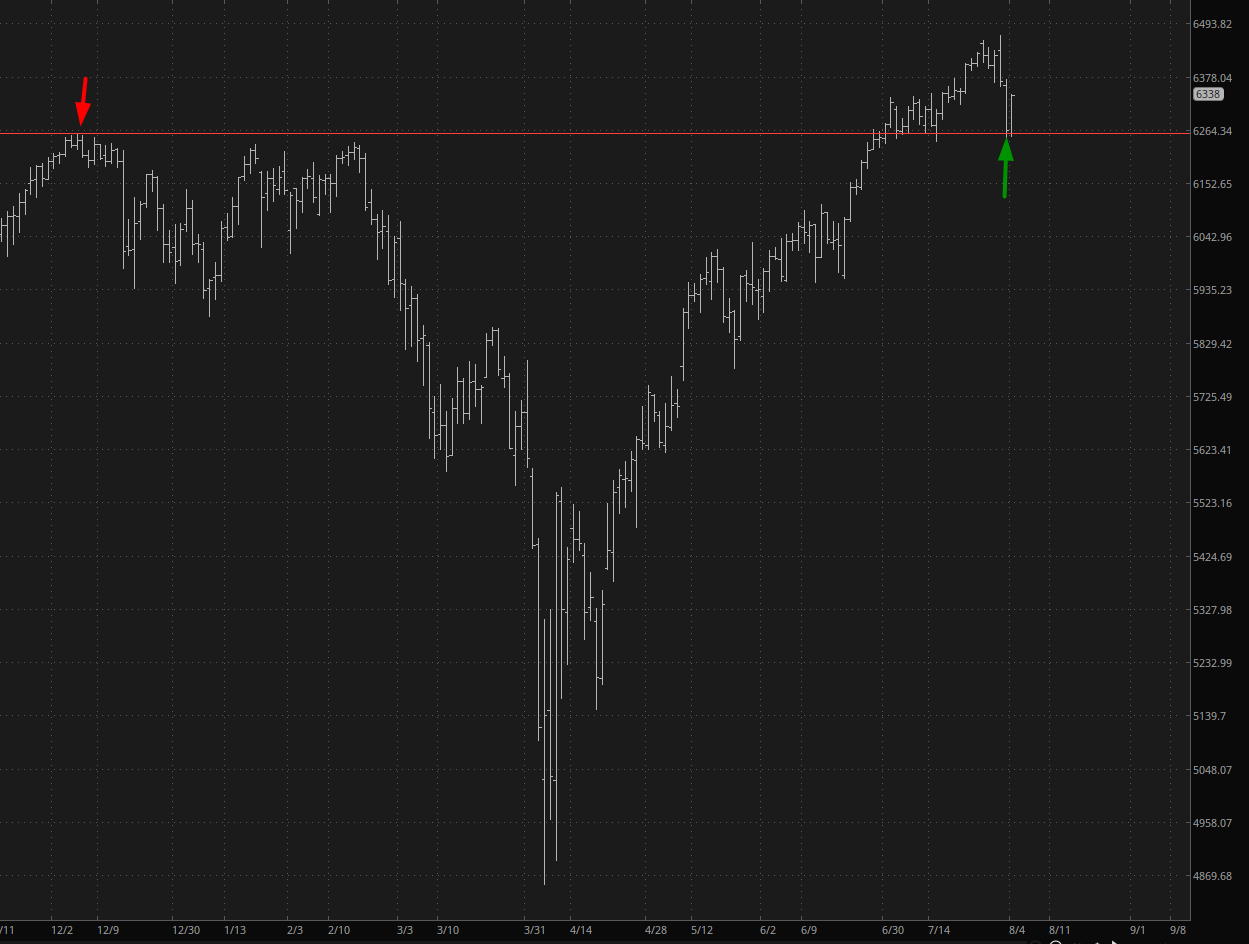
Months prior, I had marked a noteworthy point on the chart of the S&P Futures (ES), identifying a line which anchored to a previous all-time high (signified with a red arrow in the analysis). On the particularly volatile Friday in question, the ES approached this line at the peak of the downturn, almost as if drawn by a magnetic force, before rebounding sharply (highlighted with a green arrow). Remarkably, this reversal was so potent it almost entirely erased the losses of the day.
Similar behaviour was observable in the Nasdaq Futures (NQ). This tech-heavy index mirrored the S&P’s actions almost to a tee, experiencing its own sharp turnaround at a crucial technical level. The visual representation of these movements vividly captures the moment of impact and subsequent rebound, like a phoenix arising from financial ashes.
In contrast, the Russell 2000 Index (RTY), representing small-cap stocks, played by a different set of rules on this particular day. Rather than reverting at a historical peak, this index’s trajectory was influenced by a specific Fibonacci Retracement level—at 76.8%, located at 2150. Demonstrating the intricacies of market dynamics, the RTY’s lowest ebb was a mere whisker away from this point, at 2148.60, before it too made a rebound.
For those unfamiliar with Fibonacci Retracement, it’s a technical analysis tool used to predict future movements of financial markets based on the theory that markets will retrace a predictable portion of a move, after which they will continue to move in the original direction. The levels identified by Fibonacci sequences are used to determine potential support and resistance levels.
These occurrences serve as a testament to the importance of technical analysis in understanding market movements. To the uninitiated, it might seem as if stock indexes operate in a realm of chaos, subject to the whims of global news and unpredictable events. However, through the lens of technical analysis, patterns and levels of significance emerge, offering a roadmap of sorts for navigating the volatility.
For those nursing bearish sentiments, hoping for a downturn to capitalize upon, these technical levels represent formidable barriers. A breach of these thresholds would be necessary for such investors to revel in a moment of triumph. The resilience displayed by these indices at these critical junctures highlights the often underestimated power of technical factors in shaping market outcomes.
As we delve deeper into the mechanics behind these market movements, it becomes apparent that understanding these patterns requires not just a keen eye for detail but also a profound appreciation for the historical context in which these movements occur. The interplay between past highs, Fibonacci levels, and market sentiment paints a complex picture of stock market dynamics, where history, mathematics, and psychology converge.
To the casual observer, the world of financial markets might seem daunting, a sphere dominated by arcane terms and inscrutable charts. Yet, the events of that Friday, and the analysis that followed, provide a compelling entry point into understanding how markets operate. It’s a showcase of the interplay between rational analysis and the underlying emotions that drive financial decisions—greed and fear, hope, and despair.
In conclusion, while the media’s portrayal of a ‘historic plunge’ may have captured public attention, the real story lies beneath the surface. It’s a narrative about the resilience of financial markets, the significance of technical analysis, and the continuous ebb and flow of investor sentiment. As we peel back the layers of these financial fluctuations, we uncover a tapestry of human behaviour, mathematical precision, and the timeless quest to predict what comes next in the ever-evolving saga of the stock market.
