



In a world where economic forecasts, inflation rates, and central bank decisions intertwine to create an intricate tapestry of financial markets, the Australian Dollar (AUD) has recently captured the spotlight. Propelled to its zenith for the year 2025, the currency now stands on the cusp of a pivotal juncture, facilitated by its uninterrupted climb along a multi-month ascending channel. This surge in value has not only marked a significant milestone but also introduced a critical technical examination at the channel’s upper boundary. The momentum, undeniably robust and leaning towards further escalation, hints at an optimistic breakthrough, more so if the anticipated trade agreements with heavyweight economies like China and the European Union materialize.
However, the financial canvas is seldom devoid of unpredictability. Lurking on the horizon is next week’s Australian inflation report, a potential wildcard. This forthcoming data, especially if it deviates below the Reserve Bank of Australia’s (RBA) projections, might inject volatility into the market, influencing the discourse on imminent rate adjustments.
Amidst this backdrop, the RBA’s dialogue, as articulated by Governor Michele Bullock, remains compelling. Governor Bullock, taking the stage recently, conveyed a measured stance on monetary policies, mingling caution with optimism. Her insights did not betray any inclination towards the dovish pivot a faction of the board members advocated for during a previous rate decision meeting. Rather, she underscored the central narrative of inflation’s trajectory. Despite indications of a gradual deceleration in underlying inflation during the second quarter, the bank’s favoured trimmed mean indicator hinted at figures slightly above the May predictions. This subtle nuance underscores the RBA’s vigilant approach towards ensuring inflation not only gravitates back to its target but also maintains a stable orbit around the desirable 2.5% midpoint.
Furthermore, Governor Bullock’s perspectives on the labour market shed light on another dimension. The ascent in unemployment rates to 4.3% in June, although seemingly abrupt, was not deemed alarming by Bullock. Contrary to perceptions of unpredictability, she regarded this development as aligned with the bank’s earlier forecast, albeit materializing sooner than anticipated. This revelation suggests the labour market’s cooling might be unfolding at an accelerated pace, yet without immediate signs of drastic downturns. Bullock’s narrative, thus, weaves a picture of cautious optimism, maintaining a hawkish inclination without yielding to premature policy easing.
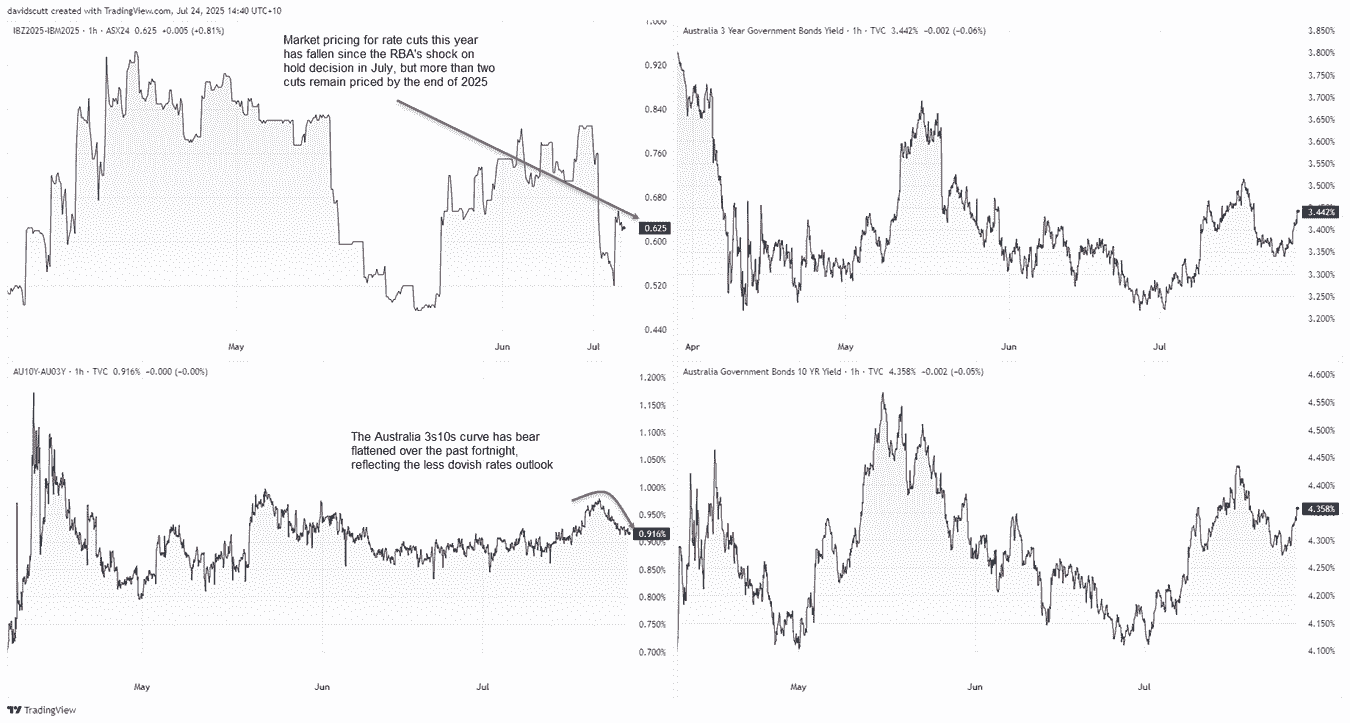
Market dynamics, juxtaposed with Bullock’s insights, reflect an intriguing duality. On one hand, the anticipation of an imminent rate cut in August is palpable, buoyed by a staggering 98% probability consensus among investors. On the other, the RBA’s recent policy surprise – opting to maintain the cash rate unchanged at 3.85% against widespread expectations of a cut – injects a degree of scepticism into forward-looking projections. Peering further down the timeline, the prospect of two 25 basis point reductions by year-end lingers, albeit with a smidgeon of uncertainty concerning additional cuts.
Diving into the crucible of domestic economic indicators, the spotlight intensifies on Australia’s imminent Q2 inflation report. With the central bank’s eye fixated on a 2.6% annual trimmed mean rate, signifying a 0.6% quarterly uptick, anticipations are rife regarding potential deviations from these forecasts. This impending release not only serves as a barometer for domestic economic health but also as a determinant of near-term monetary policy directions.
On the global platform, the AUD/USD pair’s ascendancy to 2025 highs is emblematic of a broader narrative. A buoyant risk appetite, fueled by a flurry of trade negotiations, notably with the United States, and prospects of analogous engagements with the European Union and China, has been instrumental in propelling this bullish trajectory. From a technical vantage point, the AUD/USD exchange rate now teeters on the brink of an ascending channel’s summit, presenting a formidable challenge to its bullish momentum. Technical indicators, including a resurgent Relative Strength Index (RSI) and a bullish Moving Average Convergence Divergence (MACD) pattern, advocate for an optimistic outlook. Should the pair navigate past this resistance, it sets the stage for a new echelon of trading milestones.
In summation, the narrative encircling the Australian Dollar is a mosaic of technical analyses, economic indicators, and central bank rhetoric. On the cusp of potentially pivotal developments, both domestic and international, the currency’s journey is illustrative of the broader complexities and intricacies defining global financial markets. As traders and policymakers alike navigate this landscape, the unfolding chapters promise to be as instructive as they are intriguing.
