



In delving into the labyrinth of gold trading and its pricing mechanisms, one can observe a distinct shift in market sentiment since the beginning of the week. Investors, historically seen as bullish on gold, have now adopted a more cautious stance, with skepticism creeping in about the potential for further increases in its value. This skepticism isn’t unfounded, as the contemporary geopolitical landscape, rife with tensions and uncertainties, has become a new norm, thus influencing the traditional demand and supply dynamics that drive asset valuation.
The catalyst for this renewed uncertainty was a statement made by the then US President Donald Trump, who openly declared his intention to impose trade tariffs on several of the world’s major economies. This announcement came shortly before anticipated details regarding a trade agreement between the United States and China were expected to be divulged. The implication of such a declaration by a figure of Trump’s stature led to a palpable increase in market volatility, significantly impacting gold futures.
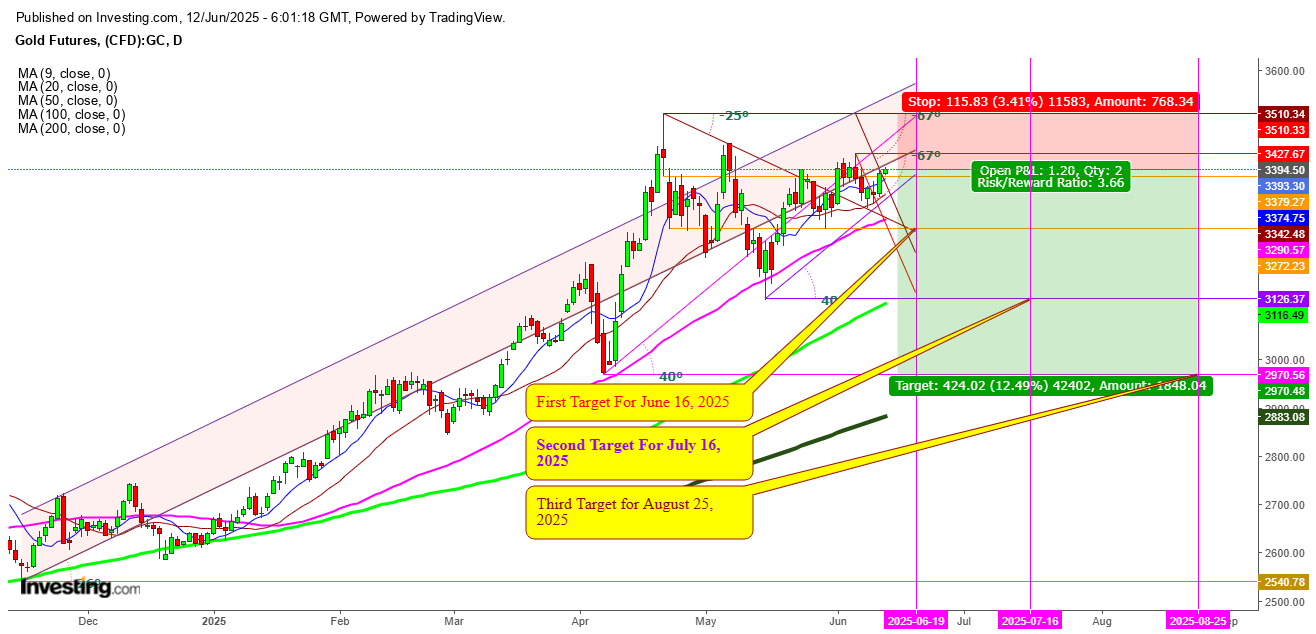
Gold futures, representing contracts to buy or sell gold at a future date, experienced a remarkable uptick the following Wednesday after managing to remain above a critical support level, identified as the 20-day Moving Average (DMA), during the preceding days. This uptick was further bolstered as prices started to stabilize above the immediate resistance level, signified by the 9 DMA, at a pricing point of $3374. Despite the uptick, the creation of a ‘hanging man’ pattern in the trading charts pointed to potential downward pressure, suggesting the emergence of an ‘exhaustive hammer’ formation that could signal a reversal in trends.
Adding to the complexity, the remarkable high of $3500, reached by gold futures in late April, turned heads in the financial world, with many analysts interpreting the ensuing consolidation phase as a precursor to further escalation. This theory was partially based on the heightened sense of uncertainty surrounding US tariffs, the release of economic data, and the implications these factors held for Federal Reserve policies in an already perplexing situation.
However, I believe that factors such as lower liquidity conditions could significantly pressure gold prices, potentially triggering a sell-off should prices fail to hold at current levels. Such a downward trajectory could become more pronounced in the weeks ahead, especially if measures to devalue the US dollar are not adopted, reflecting President Trump’s preference for a stronger national currency.
It’s noteworthy that gold, traditionally regarded as a safe haven in times of economic uncertainty, has somewhat diminished in appeal at its current elevated prices. Central banks around the globe have shown a propensity to favor alternative reserves, such as the Japanese Yen and Swiss Franc, over gold. This shift signals a potentially significant change in the traditional dynamics of gold as a fallback asset during periods of economic distress.
Looking ahead, I foresee the possibility of a bearish trend taking hold, with the market potentially positioning for short sales. Such a move could be characterized by a targeted 3.41% stop-loss placed at $3510, aiming for a 12.49% reduction to reach a price target of $2970 by August 25, 2025. More immediate targets could include a price level of $3342 by June 19, 2025, followed by a second target of $3126 by July 16, 2025, culminating in the final target of $2970 by the aforementioned August date.
It is imperative to underscore that the realm of gold trading is fraught with complexity and unpredictability. Each investor must navigate these waters with diligence and caution. The observations and analyses presented in this discourse are drawn from current market behaviors and should not be construed as financial advice. The onus of decision-making rests solely with the individual, as market conditions are perpetually in flux, influenced by a myriad of global factors beyond the scope of any single analysis.
In sum, the narrative surrounding gold and its futures is emblematic of the broader themes of uncertainty and change that define our current geopolitical and economic landscape. As with any investment, a deeply considered approach, informed by a comprehensive understanding of market forces and a keen eye on unfolding global events, remains the prudent path forward.
