



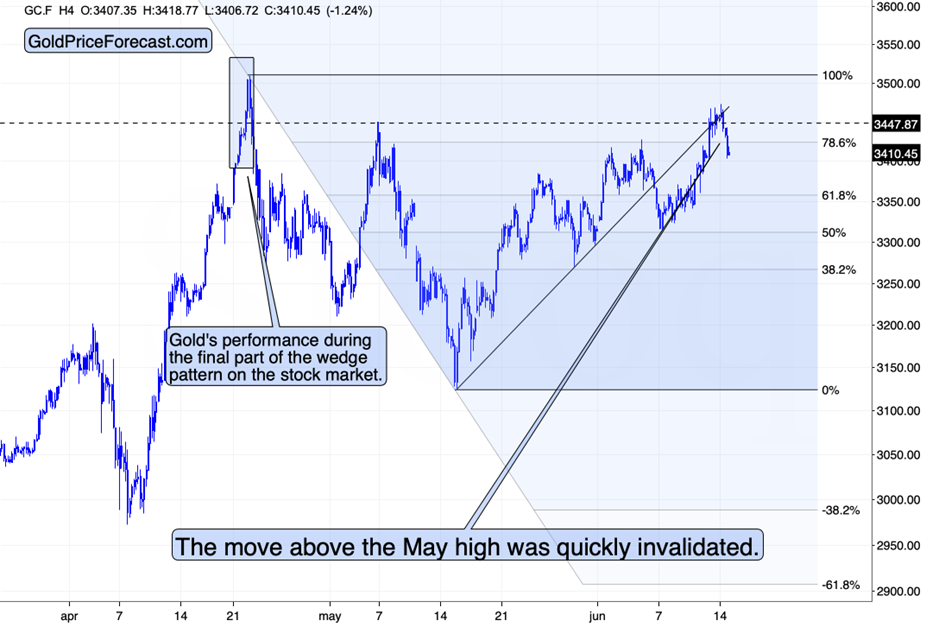
In the current climate of global financial trends and geopolitical unrest, particularly in the Middle East, one would anticipate gold – traditionally seen as a bastion of safety in times of uncertainty – to appreciate in value. However, contrary to expectations, the price of gold has recently undergone a significant decline, showcasing a decrease of over $40. This movement starkly contrasts with the anticipation of a rally in light of escalating conflicts between Israel and Iran, with both nations reportedly exchanging missile fire. Such developments traditionally prompt investors to seek refuge in stable assets like gold, yet the current situation displays a marked deviation from this trend, presenting a bearish outlook on the precious metal’s immediate future.
The recent decline in gold’s price, despite heightened geopolitical tensions, can be interpreted as a crucial signal to investors. Typically, a breakout in gold prices, fueled by external pressures such as geopolitical unrest, would suggest a bullish market for the metal. However, the current downturn, in spite of these factors, might be indicative of a selling signal. This phenomenon underlines a non-technical invalidation of what was presumed to be a breakout, suggesting that the metal is not inclined to trade higher in the current circumstances.
This unexpected bearish movement of gold mirrors a similar trend observed in late 2012, when the price of gold approached, yet failed to surpass, its previous highs, despite prevailing conditions that would traditionally favor a rally. This historical perspective adds a layer of understanding to the current market dynamics, capturing investor sentiment and market trends that transcend simple supply-and-demand mechanics.
Interestingly, this drop in gold’s value coincides with a decline in the US dollar as depicted by the Dollar Index (DXY), which tracks the currency against a basket of other major currencies. Under normal circumstances, a weakening US dollar would naturally lead to an increase in gold prices, as it makes the metal cheaper for holders of other currencies, thereby increasing demand. However, the simultaneous downturn of both assets defies conventional market wisdom, suggesting a deeper underlying market shift or sentiment that may not immediately be apparent.
The current sentiment surrounding the US dollar, characterised by concerns over its sharp decline and exaggerated predictions of the United States’ downfall, seems disconnected from the nation’s underlying economic strength. The United States maintains its position as the world’s leading economy, home to significant global technological and AI corporations, alongside possessing the most formidable military capabilities. Furthermore, US tariffs, often seen through a critical lens, could potentially serve as bullish indicators for the dollar, reinforcing its status despite short-term fluctuations.
This juxtaposition of gold’s price drop against a backdrop of a declining dollar adds a layer of complexity to the financial landscape, challenging conventional beliefs about the correlation between gold and the dollar. Moreover, it raises questions about the broader implications for commodities and stocks related to gold mining, which might also be expected to decline under such conditions.
As we delve into the intricate dynamics at play, it’s essential to consider the broader historical and economic context that shapes market movements. The rise and fall of the US dollar, viewed through the lens of its rebound after the 2008 financial crisis, paints a picture of resilience and the fluid nature of market sentiment. Similarly, gold’s current performance, diverging from traditional patterns of behavior in response to geopolitical tensions, underscores the complexity of factors influencing investment decisions in today’s global landscape.
In conclusion, the observed downturn in gold prices, amid escalating geopolitical tensions and a concurrent decline in the US dollar, offers a compelling case study on the unpredictable nature of financial markets. This anomaly provides a valuable learning opportunity, prompting investors to look beyond conventional wisdom and consider a broader array of factors when navigating the complex web of global finance. As we move forward, understanding these nuances will be crucial in making informed decisions in an increasingly interconnected and volatile world.
