



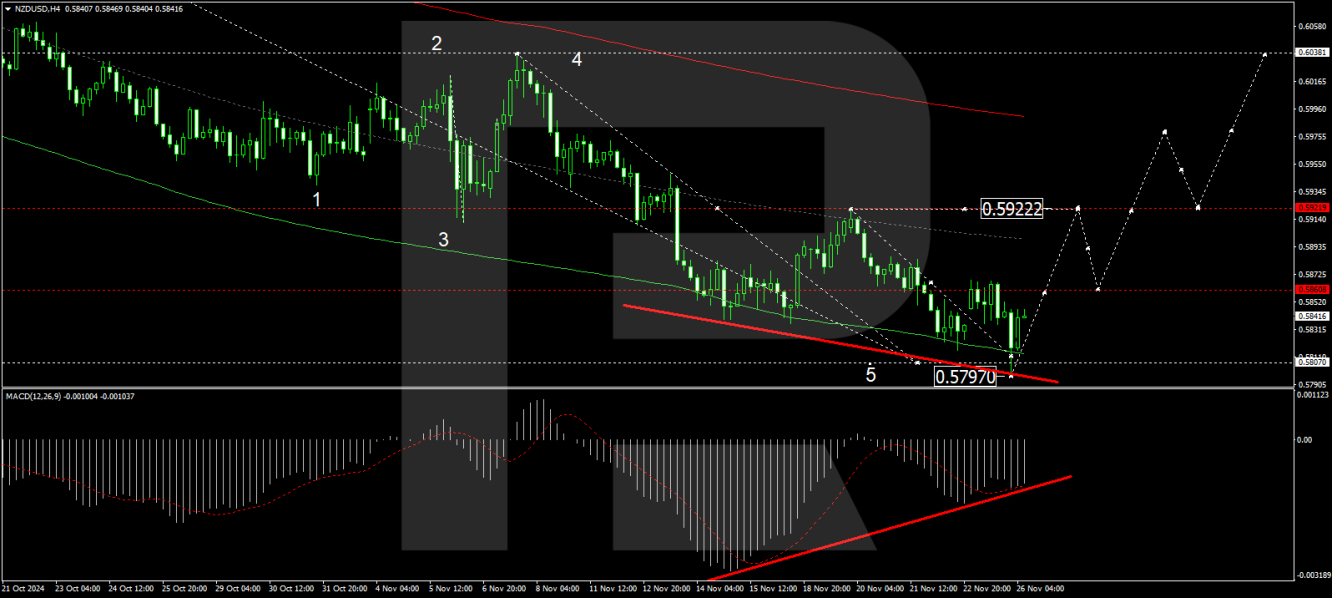
In the intricate world of foreign exchange markets, the New Zealand Dollar (NZD) against the US Dollar (USD) has undergone a significant downturn. This dip has led the NZD to plummet to a noteworthy low of 0.5841, eventually reaching its annual nadir at 0.5796. This downward trajectory has been primarily fuelled by a strengthened USD, a consequence of expectations surrounding the impending trade policies of the then-US President-elect, Donald Trump.
Donald Trump’s campaign trail and subsequent election win were marked by promises of a rigorous reassessment of US trade policies. Among the speculated changes was the imposition of an additional 10% tariff on all goods imported from China. This potential policy shift sent ripples through global markets, notably impacting the NZD. Given that China stands as New Zealand’s foremost trading partner, the ramifications of such a tariff would directly impinge upon New Zealand’s economy, thus unsettling the NZD.
Historically, the trading relationship between New Zealand and China has been a cornerstone of the former’s economic stability. China’s appetite for New Zealand’s dairy products, among other goods, has underpinned the trading dynamics between the two nations. Therefore, the mere speculation of Trump’s stringent trade policies resurrected memories of his first term, characterized by a hawkish approach to trade, casting a lengthening shadow over New Zealand’s economic prospects and, by extension, the NZD.
As market participants braced for these anticipated shifts in US policy, attention also turned towards the Reserve Bank of New Zealand’s (RBNZ) forthcoming meeting. Speculation was rife that the RBNZ might slash interest rates by 50 basis points, bringing them down to 4.25% per annum. This expectation was not unfounded, as it aligned with the RBNZ’s previously exhibited dovish stance in October. Such a move was anticipated to exert further downward pressure on the NZD, indicating a direct linkage between domestic monetary policy decisions and international forex market movements.
Turning to the analytical lens of technical analysis, the NZD/USD pair provided an interesting study. According to the H4 chart analysis, the pair had completed a downward trend, touching 0.5797, before entering a recovery phase with a target of 0.5922 on the horizon. Should this level have been attained, a potential retraction to 0.5860 was expected to create a consolidation zone around this pivot. The dynamic nature of the forex market meant that a breach below this consolidation zone could precipitate a further slide to 0.5777, whereas an upward break could potentially propel the pair towards 0.5977.
In a finer granularity, the H1 chart analysis of the pair suggested an incipient growth wave aiming for 0.5860. Subsequent to hitting this target, a retracement to 0.5828 was deemed probable. The predictive reliability of this analysis was bolstered by indicators such as the Stochastic oscillator, which hinted at a possible downturn from elevated levels, reinforcing the expectation of a continuing downward trajectory for the NZD/USD pair.
This detailed examination of the NZD/USD pair through both a macroeconomic lens and the prism of technical analysis sheds light on the multifaceted factors influencing currency movements. Economic policies, geopolitical developments, and central bank decisions intertwine to sculpt the landscape of forex markets, albeit in an environment fraught with uncertainty. Traders and analysts alike navigate this complex terrain, armed with various analytical tools, yet always subject to the whims of an ever-evolving global economy.
Lastly, it is crucial to remember that such analyses, while informative and grounded in current economic understanding, are not infallible predictions of future market movements. They embody informed speculations based on available data and trends. As such, the outcomes of trades premised on these analyses bear inherent risks and should be approached with caution, underscoring the importance of due diligence and risk management in the realm of forex trading.
Disclaimer: This article provides an analysis based on the author’s insights. It should not be construed as trading advice. Currency trading involves significant risk and may not be suitable for all investors. The author and RoboForex accept no responsibility for any trading losses incurred as a result of this analysis.
