



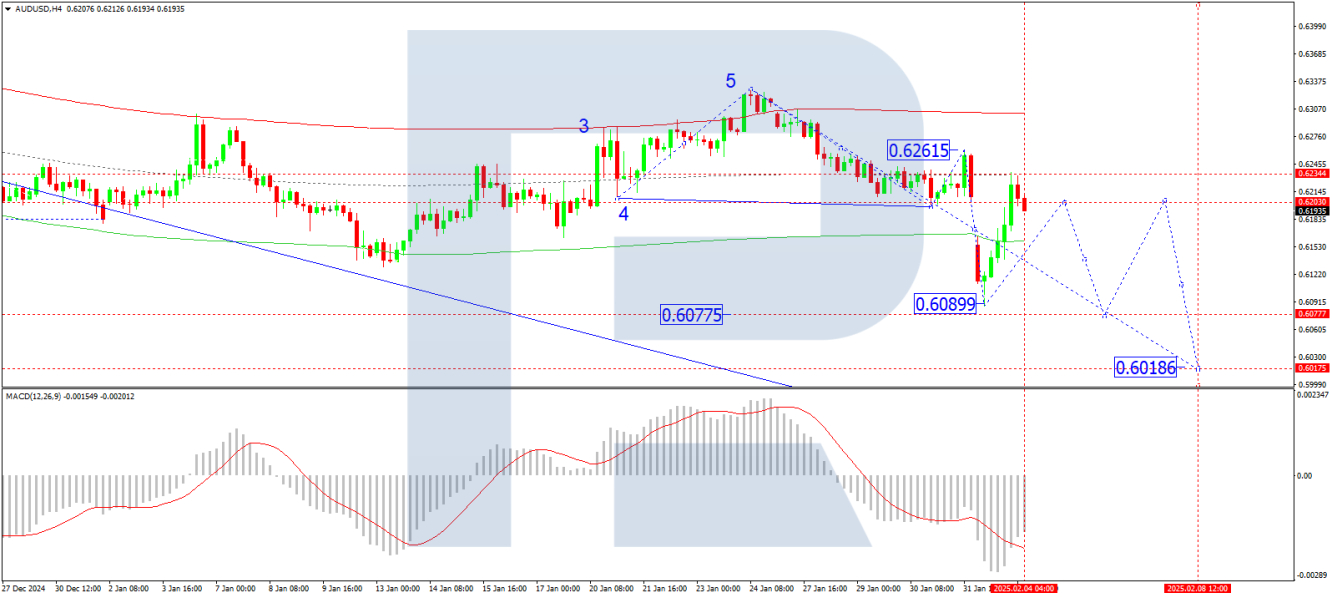
In recent developments, the AUD/USD currency pair witnessed a noteworthy rebound, touching 0.6199 on Tuesday, as it clawed back some of its earlier losses. This fluctuation came against the backdrop of a risk-averse sentiment that had taken hold of investors earlier in the week. Specifically, the Australian dollar had been grappling with multi-year lows, amidst burgeoning concerns over the impact of U.S. tariffs on key trading partners such as Canada, Mexico, and China.
The alleviation of these concerns, albeit temporary, came in the wake of U.S. President Donald Trump’s decision to postpone the implementation of tariffs on Canada and Mexico. This one-month delay, aimed at facilitating continued negotiations with the aforementioned countries, served to ameliorate the apprehensive sentiment that had besieged risk currencies, the Australian dollar included.
Exploring Key Influences on AUD/USD Dynamics
Despite this brief interlude of relief, the air of uncertainty remains thick, especially concerning China – Australia’s principal trading ally. The introduction of new U.S. tariffs on Chinese merchandise, set to commence imminently, looms large, posing potential substantial repercussions for the economic landscape. Given the symbiotic nature of the Australian and Chinese economies, any developments pertinent to China are poised to impart significant reverberations on Australia’s fiscal health and, by extension, movements within the AUD/USD currency pair.
In view of the escalating trade frictions, all eyes are on the imminent meeting between President Trump and Chinese President Xi Jinping. Amidst China’s endeavours to circumvent an exacerbation of trade hostilities, it is anticipated that the U.S. administration will tactically leverage the situation. The outcome of this high-stakes dialogue is expected to be a determinant of risk sentiment across global financial markets for the foreseeable future.
Domestically, Australia’s economic pulse will soon be gauged with the release of the trade balance data for December on Thursday. This crucial report is set to offer insights into the vigour of Australia’s export-driven economy. Moreover, it may influence the monetary policy direction of the Reserve Bank of Australia (RBA), considering the pivotal role of trade in shaping Australia’s economic narrative.
Technical Analysis: A Glimpse into AUD/USD Projections
Delving into the technical analysis reveals intriguing trends within the AUD/USD currency pair. On the H4 chart, the pair initially exhibited a downward trend to 0.6088, followed by a corrective ascent to 0.6233. The anticipation, rooted in current market dynamics, points towards the initiation of another bearish wave aiming for 0.6077, potentially succeeded by a counteractive movement back towards 0.6230, hinting at a consolidation phase. A breakout from this phase could precipitate another correction, this time towards 0.6290. Conversely, a downward breach could signal the continuation of the bearish wave to 0.6077. The MACD indicator corroborates this scenario, with its signal line dramatically inclined downwards from above the zero mark, emblematic of a potent bearish momentum.
Moreover, a closer examination of the H1 chart accentuates a consolidation pattern near 0.6160, succeeded by a bullish correction to 0.6230. The anticipated trajectory involves a new bearish wave aiming for 0.6150, with a potential to extend losses further to 0.6077, should the level be transcended. The Stochastic oscillator lends credence to this bearish outlook, its signal line diverging below 80 and angling towards 20, emblematic of mounting bearish pressure.
Concluding Thoughts
In summation, while the Australian dollar has demonstrated resilience with a modest revival, it continues to navigate a path fraught with risks, primarily attributable to the ongoing trade discord between the U.S. and China. Although short-term technical indicators flirt with the prospect of further depreciation, critical thresholds at 0.6150 and 0.6077 warrant close observation. The impending discourse between Trump and Xi Jinping, alongside Australia’s impending trade balance report, are pivotal events that are bound to offer critical directional clues to market participants.
Given the intricate interplay between geopolitical developments and economic indicators, this narrative unfolds within a broader context of global dynamics and domestic economic health. As we proceed, the capacity of Australia to manoeuvre through these challenging times remains a subject of keen interest to observers and stakeholders alike.
Disclaimer
It is imperative to acknowledge that the forecasts and analyses presented herein are derived from the author’s personal perspective. Consequently, this content should not be construed as trading advice. The responsibility for trading results borne from adhering to these recommendations or reviews rests solely with the reader.
