



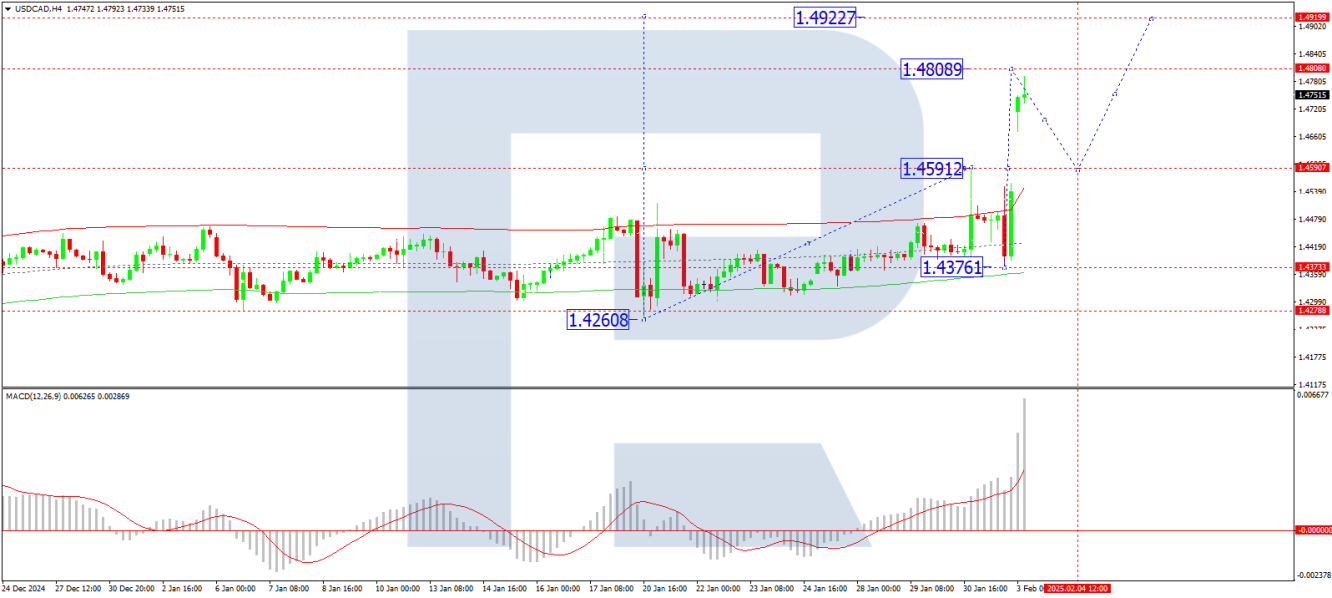
The recent surge in the USD/CAD exchange rate to levels not seen since April 2003, peaking above 1.4760 on a Monday, delineates a critical juncture in the financial narrative between the United States and Canada. This notable ascent can chiefly be attributed to the U.S. government’s strategic imposition of a 25% tariff on Canadian imports, a decision that carries profound implications for the Canadian dollar, colloquially known as the Loonie.
Rationale Behind the U.S. Tariff Implementation
At the heart of these fresh tariffs, as articulated by the White House, is a multifaceted strategy aimed not just at curbing illegal immigration but also at stifling illicit trade practices. While the intent may focus on broader geopolitical issues, the immediate economic fallout cannot be overstated, especially for a country like Canada, whose economy is significantly propelled by commodities.
In concert with the overarching tariff, Canadian energy exports found themselves subject to a slightly more lenient 10% tariff—a rate that, while less severe than anticipated, still heralds significant challenges for the sector. Pertinently, this tariff stratagem wasn’t exclusively trained on Canada. Mexico faced similar impositions, whereas Chinese goods were taxed at a 10% import duty. In a show of economic resilience and sovereignty, all affected nations have articulated plans for retaliatory measures, signaling an escalating trade skirmish that could have wide-ranging ramifications.
Implications for the Canadian Economy
Canada’s economic engine, heavily reliant on exports, now confronts a substantial adversarial phase. The erosion of foreign demand, precipitated by these new trade barriers, is likely to constrict foreign currency inflows, therein placing downward pressure on the Canadian dollar. This development warrants a closer examination of the impending economic data out of Canada, with investor eyes particularly trained on the forthcoming December figures, anticipated to unveil a modest 0.2% growth. Such an outcome would be in harmony with the projections set forth by the Bank of Canada (BoC), suggesting an annual expansion rate of 1.4%.
The BoC, in response to the evolving economic landscape, executed a reduction in its benchmark interest rate by 25 basis points, setting it at 3.0% per annum. This maneuver was accompanied by an announcement signaling the culmination of its quantitative easing programme. Moreover, the central bank has underscored its strategy to recommence asset purchases come March, a policy move likely to further muddy the waters for the Canadian dollar.
Navigating USD/CAD Movements: A Technical Perspective
From a technical analysis vantage point, the notable breakthrough of the USD/CAD pair past the 1.4591 mark, embarking on an upward trajectory, signals a potent bullish momentum. This breach clears a path to the next local target set at 1.4808, post which, a temporary retracement to 1.4591 could materialize before the pair ascends anew, aiming for 1.4919. The market’s bullish inclination is corroborated by the Moving Average Convergence Divergence (MACD) indicator, whose signal line’s position above zero and sharp upward tilt endorse the prevailing momentum.
A granular scrutiny on the H1 chart reveals the pair’s sustained upward structure peaking at 1.4742, with subsequent consolidation around this level. The consolidation’s resolution—either breaching above the range signaling a journey towards 1.4808 or a downward break mandating a correction towards 1.4591—will be crucial in determining the pair’s short-term trajectory. In conjunction, the stochastic oscillator intimates at an imminent short-term pullback, evidenced by its signal line poised above 80 and on the verge of descending towards 20.
Synthesizing the Outlook
The landscape for the Canadian dollar is markedly fraught with uncertainty, courtesy of the U.S. trade tariffs menacing future export demand. While technical indicators prognosticate a plausible further elevation of the USD/CAD pair towards 1.4808, an interim corrective phase touching 1.4591 is also within the realm of possibility before the onset of another growth spurt. Amid this volatility, the imminent release of Canadian GDP data, coupled with unfolding developments on the trade retaliation front from affected countries, stands as pivotal determinants of the USD/CAD pair’s future course.
In this complex economic tapestry, stakeholders and market observers alike must navigate with acuity, keeping abreast of macroeconomic indicators and geopolitical developments that could sway market dynamics in unforeseen ways.
Disclaimer: This analysis represents the author’s individual viewpoints and should not be construed as trading advice. RoboForex disclaims any responsibility for trading outcomes derived from recommendations and reviews within this segment.
