



In recent market developments, the cost of crude oil experienced a downturn, settling below the $73 per barrel mark as the trading week approached its conclusion. This decline is part of a broader trend that has seen values diminish, influenced significantly by the strengthening of the U.S. dollar. The financial trajectory of the week has been heavily dictacted by the U.S. Federal Reserve’s subtle hints at a gradual reduction of borrowing costs projected for 2025, which subsequently propelled the U.S. dollar to a zenith not witnessed in over two years. This surge in the dollar’s value has instigated apprehensions surrounding the global demand for fuel. Such concerns are particularly pronounced in emerging markets, where commodities priced in dollars become more burdensome to procure.
Adding to the market’s unease is the uncertainty surrounding China’s economic resurgence. With Sinopec, China’s premier refining conglomerate, postulating that the nation’s domestic demand for petrol likely reached its zenith the preceding year, the anticipation for fuel consumption in 2025 has been notably overshadowed. Given China’s pivotal role in energising global fuel consumption, this diminution in demand casts a protracted pall over the worldwide crude markets, exerting further downward pressure on prices.
On the supply front, the market has received ambiguous signals. Data disseminated earlier in the week by the U.S. Department of Energy highlighted a contraction in oil reserves, momentarily fostering a bullish sentiment on prices. Yet, this optimism was ephemeral. The decision by Kazakhstan to uphold extended production cuts under the OPEC+ agreement was initially viewed as a potentially stabilising factor. However, it has struggled to significantly buoy prices in the face of overarching market apprehensions.
Further complicating the landscape is the scaling up of production capabilities outside the OPEC domain, particularly by the U.S. and other non-OPEC countries. Coupled with China’s dwindling energy appetite, these dynamics portend a somewhat subdued closure to the year 2024 for oil prices, with scant optimism for a robust recovery.
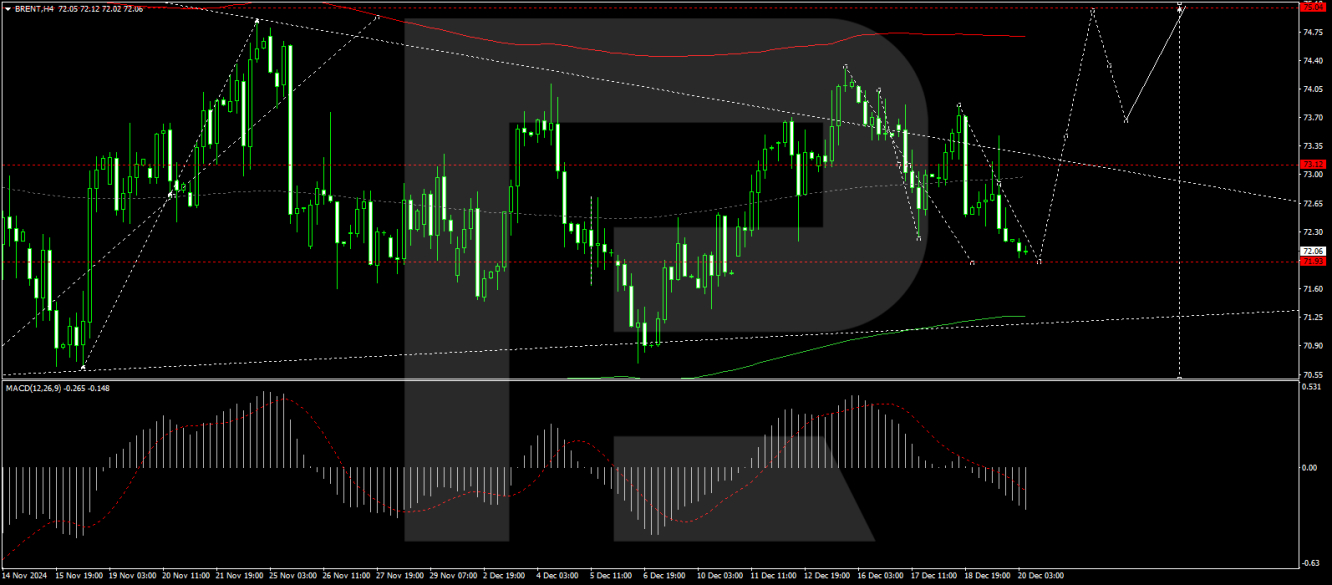
An analytical foray into Brent crude’s technical terrain reveals insightful details. On the H4 timeframe, Brent has meandered within a wide consolidation bracket around the $73.13 level, briefly peaking at $73.40 before a potential retraction to $71.93 gained likelihood. A breach beyond this range to the upside could target the $75.05 mark, with aspirations for an advance towards $80.00. The MACD indicator, positioned below the neutral zero level amidst recent lows, hints at an impending market reversal towards upliftment, potentially ushering in a new phase of growth.
Further scrutiny on the H1 chart predicates a similar narrative, with Brent consolidating around $73.13. The current wave pattern hints at a dip towards $71.93, succeeded by an anticipated corrective upswing back to $73.13. Surmounting this resistance could infuse the market with momentum, targeting $75.05 and possibly higher territories.
This comprehensive analysis, while derived from meticulous evaluation, should be approached as an informed perspective rather than prescriptive trading advice. It is crucial for market participants to conduct their due diligence, as the outcomes of trading decisions rest solely upon individual discretion.
In light of the aforementioned dynamics, the global oil market stands at a complex crossroads, marked by fluctuating demand concerns and a labyrinth of supply-side measures. As countries grapple with evolving economic landscapes and shifts in energy consumption patterns, the trajectory of oil prices remains an emblematic reflection of broader geopolitical and economic undercurrents.
