



In the waning days of a week marked by escalating geopolitical tensions, the financial markets in the United States exhibited a restrained reaction, with equities experiencing only a slight downturn on Friday. This tepid response—epitomized by a mere 1.13% drop in key indices—came in the wake of a significant military onslaught by Israel on Iranian targets, swiftly followed by Iran’s robust counterstrikes. Market optimism seemed to hinge on the assumption that Israel’s initial offensive might swift enough to preclude a drawn-out conflict. However, this hope was soon tempered by a series of missile barrages launched by Iran against both civilian and economic landmarks within Israel, signaling the potential for a protracted and mutually destructive conflict.
For observers both within the United States and globally, the unfolding crisis in the Middle East raises pressing questions about the implications for personal financial portfolios. Central to these concerns is the strategic Strait of Hormuz, through which a substantial portion of the world’s oil supply transits.
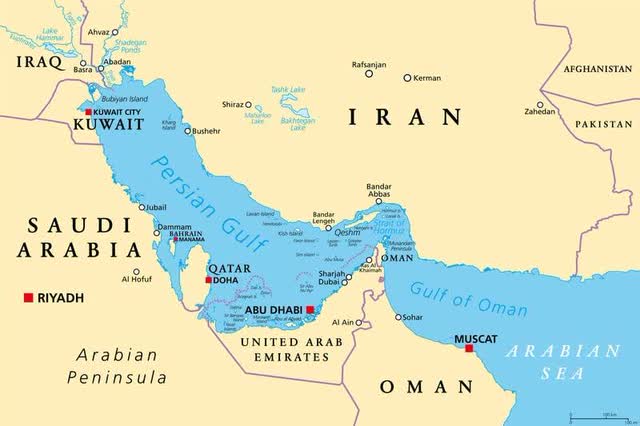
This maritime corridor, linking the Persian Gulf with the Arabian Sea and the wider world, is a slender waterway crucial for the global energy supply. At its narrowest, the Strait spans approximately 20 miles, with the navigable channels shrinking to a mere two miles in width. The geography of the Strait, characterized by its narrowness and strategic positioning, renders it susceptible to blockades via methods such as mining, sinking of vessels, or targeted attacks using missiles and drones.
To grasp the magnitude of its importance, consider that nearly 20% of global oil supplies pass through the Strait of Hormuz. This fact underscores the profound vulnerability of international energy markets to disruptions in this narrow passage. Moreover, Iran’s military capabilities, honed over years of strategic planning and tactical investments, position it to feasibly halt the flow of commercial traffic through the Strait, an action that would have far-reaching implications for global energy prices and, by extension, the world economy.
The insurance industry plays a critical role in this delicate balance, as insurers are unlikely to cover vessels navigating through a conflict zone, effectively rendering the Strait impassable without necessitating a single shot being fired at a commercial ship. In essence, the Strait’s closure would not result from direct military action by Iran but from the collective risk aversion of maritime insurers and shipping companies.
The potential consequences of a prolonged closure of the Strait are dire, with predictions suggesting a possible tripling or even quadrupling of global oil prices. Historical parallels, such as the 1973-1974 oil embargo, offer a glimpse into the economic turmoil that can ensue from major disruptions in oil supply, even when the actual decrease in global oil availability is relatively small. In the current context, an 18-20 million barrels per day disruption would represent an unprecedented shock to the global supply chain, with the potential to push oil prices beyond $300 per barrel.
Such a price shock could precipitate a major economic downturn, as history shows that significant increases in oil prices have frequently heralded the onset of recessions in the United States and elsewhere. The interplay between oil prices and economic health is complex, but the correlation between sharp price increases and subsequent economic contractions is well-documented, pointing to the potential for widespread financial instability in the event of a shutdown of the Strait of Hormuz.
The motivations behind Iran’s potential closure of the Strait are multifaceted, essentially boiling down to a strategic maneuver akin to geopolitical blackmail. Faced with existential threats from Israel and, by extension, the United States, Iran may perceive the obstruction of the Strait as a means of exerting pressure on the international community to facilitate a cessation of hostilities. This tactic, though fraught with risk for Iran itself, underscores the critical strategic value of the Strait of Hormuz not only as an energy corridor but as a bargaining chip in the complex web of Middle Eastern geopolitics.
As the situation continues to evolve, with Israel’s military actions and Iran’s threats hinting at an impending blockade, the global community watches with bated breath. The closure of the Strait of Hormuz would not only mark a significant escalation in regional hostilities but would also set the stage for a global economic crisis of potentially unprecedented scale.
In conclusion, the Strait of Hormuz stands as a linchpin in the global energy supply chain, its strategic importance magnified by the volatile geopolitical climate of the Middle East. As the potential for conflict looms large, the repercussions for global markets, oil prices, and the broader economy promise to be profound. As such, the situation warrants close monitoring, with implications that extend far beyond the immediate confines of the region, touching on the economic well-being and energy security of nations worldwide.
