



In the financial realm, the dance of currency pairs is a spectacle that continually captivates investors and policy-makers alike. Among these, the USD/JPY pair holds a spot of notable interest due to its reflection of the interplay between the United States and Japanese economies. Recently, the USD/JPY exchange rate has inched its way up, though it remains shackled beneath a critical resistance trendline established in 2025. This article delves into the nuances of this dynamic, providing insights that are invaluable whether you’re a seasoned market watcher or new to the financial forecasting arena.
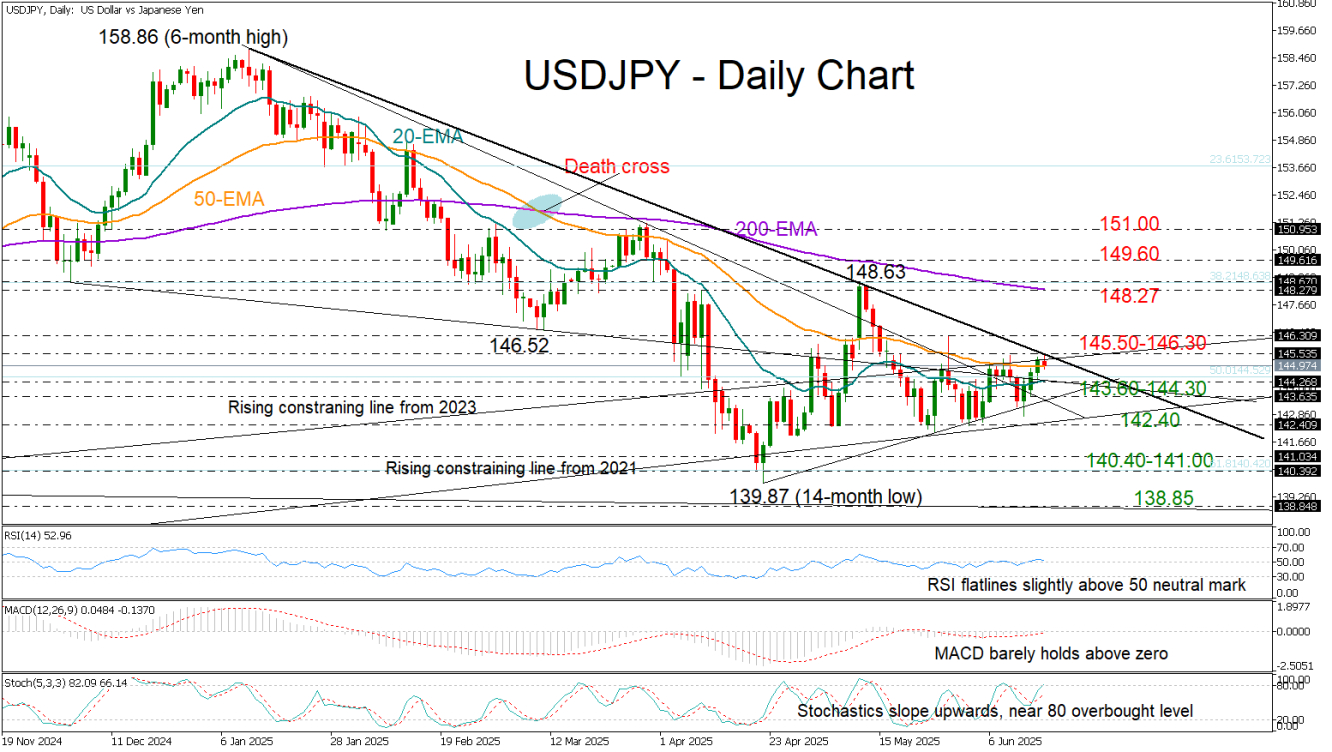
As of the last week, the pair managed to maintain stability above the 143.00 benchmark, showcasing a noteworthy comeback peaking near the 145.50 mark. This movement was propelled towards testing a significant resistance trendline that has been knitting together the highs of January and May 2025. Yet, as investors hold their breaths in anticipation of the Federal Open Market Committee (FOMC) policy announcement expected at 18:00 GMT, the momentum around this currency pair remains tenuously subdued.
The FOMC’s forthcoming declaration looms large over the markets, with participants eager to discern the Federal Reserve’s next moves. Despite expectations leaning away from rate cuts, the economic landscape is anything but straightforward. The smoldering conflict between Israel and Iran has thrust an additional layer of uncertainty upon the global inflation outlook, presenting a Gordian knot for the central bank’s policy easing efforts.
From a technical standpoint, the horizon appears cautiously optimistic for the USD/JPY pair. Indicators such as the Relative Strength Index (RSI) mildly tip above the neutral median of 50, while the Moving Average Convergence Divergence (MACD) hovers just above both its signal and zero lines—hinting at a fragile bullish momentum. Should buyers muster enough strength to propel the pair decisively above the 145.50 threshold, piercing through the 146.30 barricade, it could herald the onset of a more robust recovery. Success in this endeavor would then target the 200-day exponential moving average (EMA) at 148.27, with further aspirations stretching towards an initial resistance at 149.60, before eying the 151.00 horizon.
Conversely, an escalation in selling pressure could see the USD/JPY duo grappling with support in the 143.60–144.50 realm. A breach below this sanctuary could unravel the path towards the 142.40 mark. Failing to hold this line could precipitate a downward spiral towards the 140.40–141.00 region, leaving the next substantial support hovering around 138.00—marked by the ascending trendline from January 2024.
To encapsulate, while the USD/JPY has demonstrated signs of stabilizing and even tentative advance, the path to a bullish breakout demands a decisive and sustained ascendancy above the 145.50–146.00 resistance frontier. Such a breakthrough remains the linchpin for igniting stronger upward momentum.
Understanding the Context:
For those not intimately familiar with the financial market’s pulse, the FOMC’s decisions are pivotal for setting the United States’ monetary policy, significantly impacting currency exchange rates. The USD/JPY pair serves as a barometer for investor sentiment and economic health between the US and Japan—two of the world’s foremost economies. The ebb and flow of this currency pair reflect broader geopolitical, economic, and monetary policy shifts, offering insights into the global financial landscape’s underlying currents.
In this milieu, the ongoing Israel-Iran conflict adds an additional layer of complexity, influencing oil prices and, subsequently, inflation rates—a crucial metric for the Federal Reserve when determining monetary policy. The intricate dance between maintaining economic stability and responding to global crises poses a formidable challenge for policymakers.
For investors and market analysts, tracking movements like those of the USD/JPY pair provides critical intelligence for investment decisions. In understanding the nuances of these dynamics, one gains not only a window into the current state of financial markets but also a foresight into potential future movements. As we edge closer to the FOMC’s announcement and beyond, the currency markets remain a compelling narrative of economic resilience, policy-making, and the perpetual quest for equilibrium in a fluctuating global landscape.
