



Amid the anticipation surrounding the Bank of England’s upcoming decision on interest rates, the British Pound against the US Dollar (GBPUSD) pair has displayed a notable downtick in its value. This financial dynamic unfolds as the market braces for the central bank’s policy update, which is broadly anticipated to hold the benchmark interest rate steady at 4.25%. This piece aims to dissect the underpinnings of the GBPUSD’s recent movements, delving into technical indicators and broader economic narratives influencing its trajectory, thus providing a comprehensive overview for both seasoned market watchers and those less familiar with the financial intricacies of currency pair fluctuations.
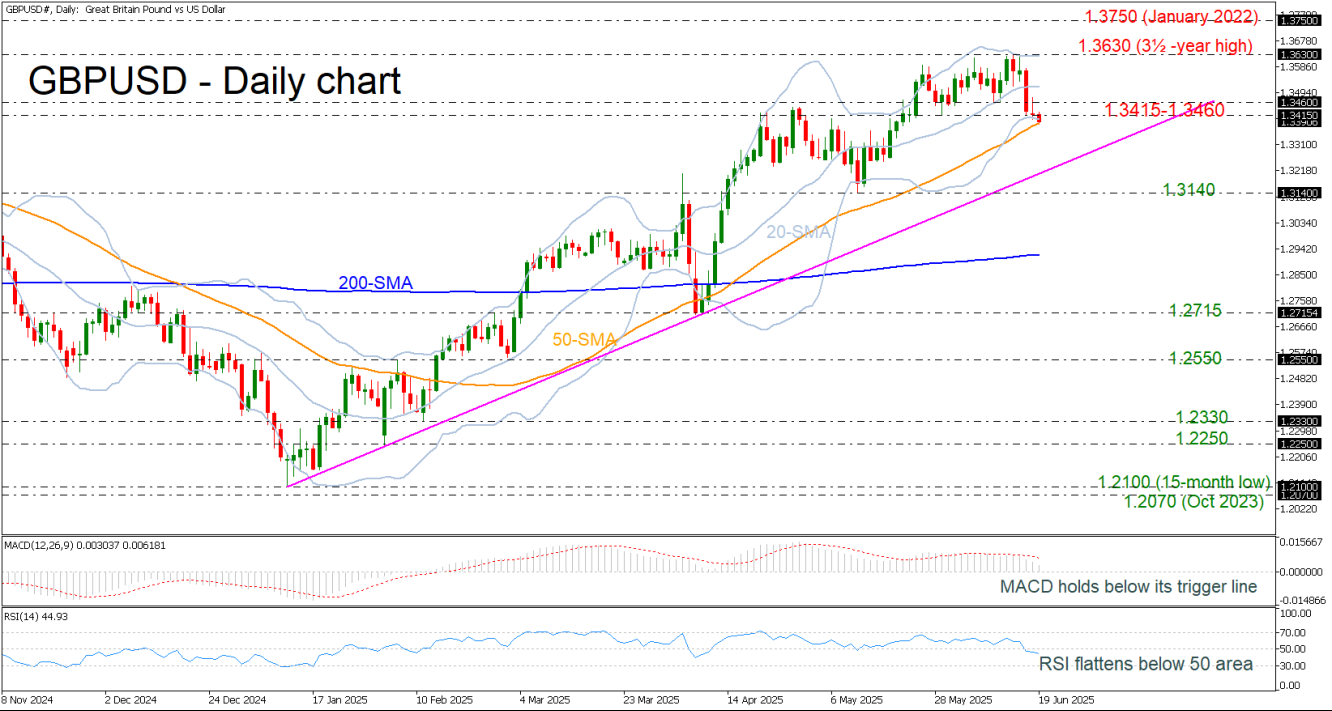
The GBPUSD pairing has recently edged closer to the lower boundary of its Bollinger Bands, a technical analysis tool used to gauge volatility and price levels. Concurrently, the currency pair has managed to stay above a crucial uptrend line, depicting a longer-term inclination towards growth, despite short-term setbacks. This current position is a delicate juncture, hinging on imminent economic announcements and underlying market sentiments.
A closer look at the currency pair’s movement reveals that it’s flirting with the 50-day Simple Moving Average (SMA), identified at 1.3390. This metric serves as a barometer for the average price level over recent periods, and its current proximity suggests a pivotal moment for the GBPUSD pair. Should the selling momentum maintain its strength, there’s a palpable risk of the pair descending towards a medium-term ascending trendline, approximated near 1.3280. An escalation of this downward momentum might set the stage for the pair targeting the 1.3140 support level, beyond which the 200-day SMA at 1.2920 looms as a significant technical checkpoint that could stymie further depreciation.
Conversely, a resurgence in buying activity at or near the 50-day SMA might kindle a bullish revival, potentially driving the pair into a resistance zone bracketed between 1.3415 and 1.3640. A successful penetration of the Bollinger Band’s midpoint around 1.3515 would pave the path towards challenging the three-and-a-half-year zenith at 1.3630. This scenario hinges on a complex interplay of market sentiment, economic data releases, and broader macroeconomic trends.
The current bearish sentiment surrounding GBPUSD is corroborated by leading technical indicators. The Moving Average Convergence Divergence (MACD) is currently tracking below its signal line, denoting bearish momentum. Meanwhile, the Relative Strength Index (RSI), which measures the magnitude of recent price changes to evaluate overbought or oversold conditions, is resting beneath the neutral line of 50 – another hint at the prevailing downward bias.
Amid these technical readings, the imminent Bank of England (BoE) rate decision casts a significant shadow over the GBPUSD pair’s immediate direction. The central bank’s interest rate policy is a critical lever in its macroeconomic management toolkit, influencing borrowing costs, consumer spending, and overall economic growth. A decision to maintain rates could signal the institution’s assessment of prevailing economic conditions, including inflationary pressures and growth prospects. For the GBPUSD pair, the rate announcement is a pivotal event that could either exacerbate the current downtrend or catalyze a technical rebound, depending on the market’s interpretation of the BoE’s outlook and accompanying commentary.
Adding a historical perspective, the GBPUSD pairing, often termed ‘Cable’ in homage to the transatlantic communication cable that once transmitted exchange rate information between London and New York, has been a barometer for the financial and economic health of the United Kingdom and the United States. It encapsulates shifts in global trade dynamics, monetary policy alterations, and broader geopolitical events. The currency pair’s movements offer nuanced insights into the interplay between the UK’s economy and broader global financial currents.
As we stand on the cusp of the BoE’s rate decision, market participants are meticulously parsing through data, narratives, and technical indicators, attempting to anticipate the pair’s forthcoming trajectory. Whether the GBPUSD pair sustains its bearish tilt or pivots towards recovery, its journey encapsulates the complexities of global financial markets — influenced by policy decisions, economic data, and the perpetual oscillations of supply and demand for currencies on the global stage.
In summary, the GBPUSD’s flirtation with lower technical thresholds, amidst an overarching downtrend ahead of a crucial BoE rate decision, underscores the multifaceted influences steering its path. As investors and observers alike await the outcome, the intersection of technical patterns, economic indicators, and policy pronouncements will dictate the next chapter in the storied evolution of this key currency pair.
