



In the first quarter of 2025, New Zealand’s economy exhibited a performance that defied expectations, showcasing a robustness in its economic activities that was both impressive and surprising to many. But the reaction of New Zealand’s currency, the Kiwi, to this economic upturn was far less enthusiastic. On a particular Thursday, it experienced a sharp downturn, influenced heavily by growing geopolitical tensions that led to a widespread decrease in risk appetite among investors. This resulted in a significant technical downfall for the Kiwi, suggesting that this bearish trend might endure for a while longer.
Overview of NZD/USD Dynamics
At the outset of 2025, the New Zealand economy kicked off with remarkable vigour, a development that, under normal circumstances, might have bolstered the national currency. However, the opposite happened on that Thursday, with the NZD/USD exchange rate plummeting to its lowest levels in several weeks. The retreat of investors towards safer assets marked a period of increased risk aversion, further pressurizing the NZD/USD pair and breaching significant technical levels. This shift paves the path for a possible extended downturn, especially if global risk appetites continue to dwindle.
Analysis of New Zealand’s Economic Surge
The first-quarter growth rate for New Zealand stood at 0.8%, a figure that comfortably surpassed the Reserve Bank of New Zealand’s (RBNZ) projection of 0.4%. This economic expansion was primarily fuelled by a surge in the production of goods. However, despite this quarterly growth spurt, the annual Gross Domestic Product (GDP) reflected a decline of 1.1%, signaling persisting vulnerabilities within the broader economic landscape.
Significant contributions to this economic growth came from rebounds in transport equipment and machinery sectors, each seeing a 2.4% increase. The information technology domain also saw significant uplift, alongside healthcare, which contributed with a sturdy 1.4% growth. The rebound was notably pronounced in goods-producing industries, which saw a 1.3% increase following a significant decrease in the previous quarter. Contrastingly, the services sector, which constitutes 73.6% of the GDP, experienced a modest rise of 0.4%.
Despite outperforming market predictions and RBNZ forecasts, the GDP data was viewed by traders with a degree of skepticism, considering it more a reflection of past performance with limited bearing on current economic realities.
NZD/USD Technical Breakdown
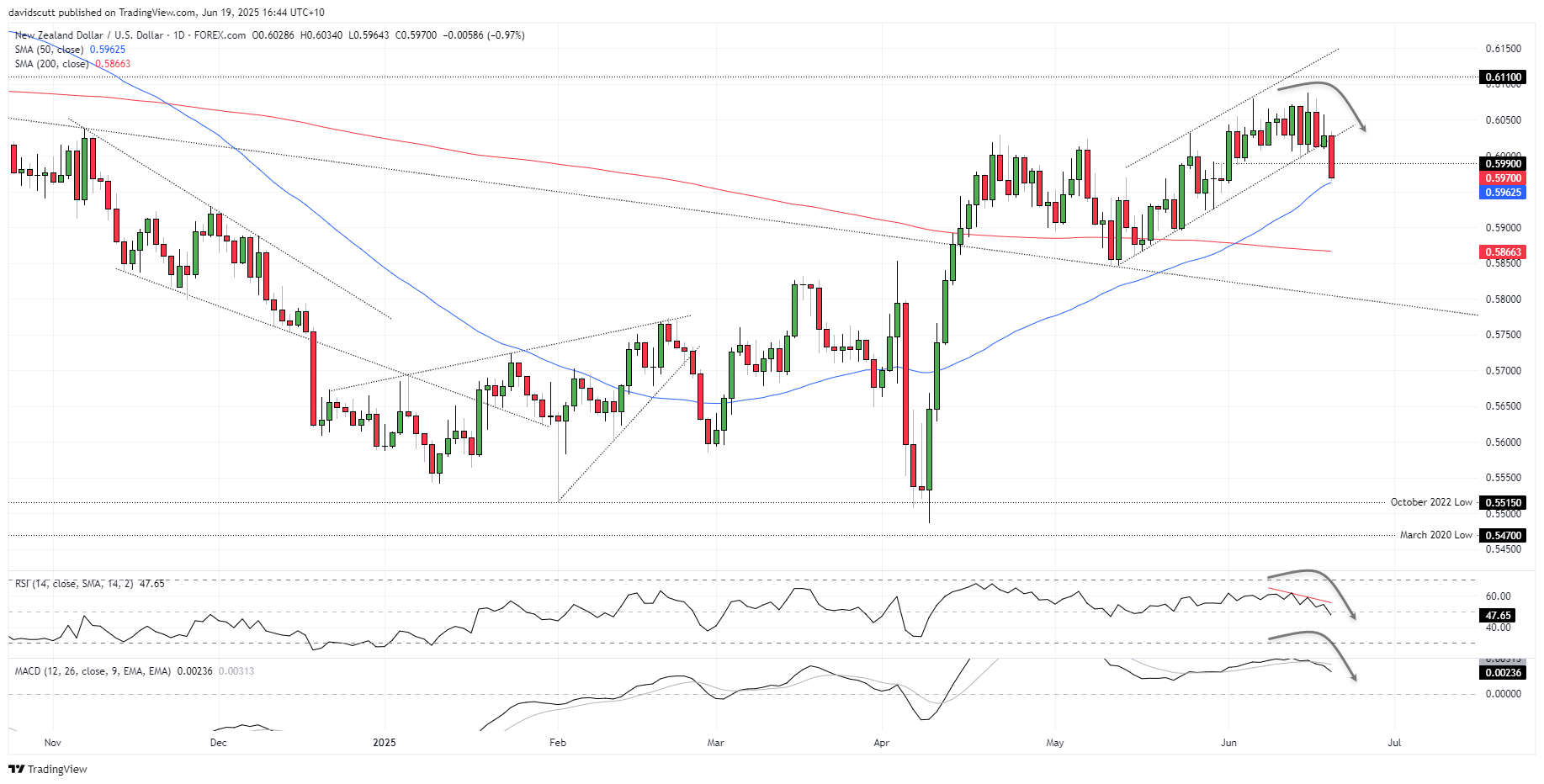
The downward trajectory of the NZD/USD pair became more pronounced, dropping to levels unseen since the early parts of June. This decline wasn’t solely attributable to internal factors within New Zealand but was significantly influenced by international news – a report by Bloomberg highlighting the US’s preparation for a potential military engagement with Iran ignited fears of geopolitical instability, leading investors to shy away from riskier assets, including the NZD. This news prompted the NZD/USD to breach its channel support, which had been under pressure for several days, effectively sweeping away the support from buyers at the crucial .6000 level.
Technical indicators such as the Relative Strength Index (RSI) and the Moving Average Convergence Divergence (MACD) signalled a continuing downtrend. The RSI was observed moving below the 50 mark, while the MACD, despite remaining above zero, had crossed below the signal line, indicating a shift towards bearish momentum.
Key levels to monitor in the wake of this downturn include the 50-day moving average at .5925, a point from which the Kiwi previously recovered in late May, followed by .5900 and the crucial 200-day moving average. Resistance levels, particularly .5990, which initially provided support, might now act as barriers against any potential upward corrections.
Conclusion
The beginning of 2025 brought with it a tale of two realities for New Zealand – on one hand, a surprising economic upturn showcasing the resilience and potential of its economy, and on the other, a plight faced by its currency amidst rising global uncertainties and shifting investor sentiments. This encapsulates the complex interplay between economic fundamentals and market psychologies, where even significant domestic achievements can be overshadowed by broader, more speculative geopolitical concerns. This situation serves as a vivid reminder of the intricacies involved in global finance, where local success stories can sometimes be clouded by the unpredictable nature of international relations and investor behavior.
