



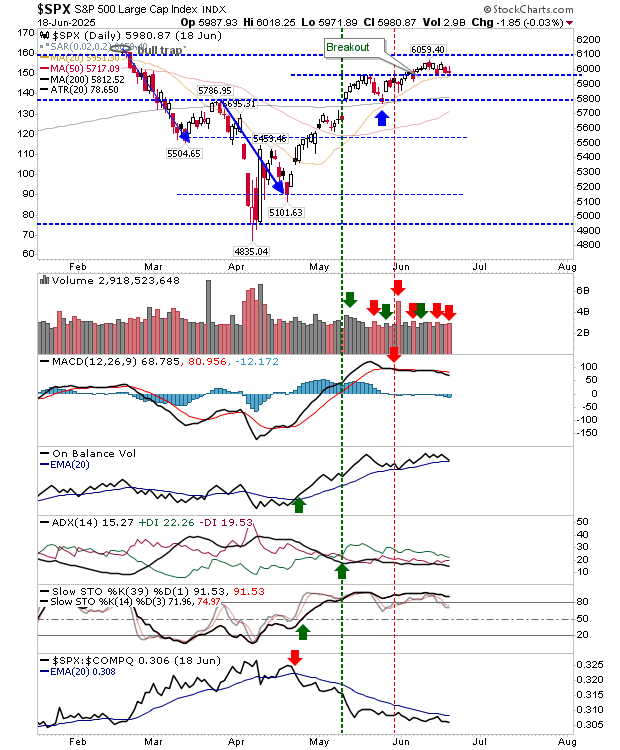
In recent times, global financial markets have displayed a noteworthy pause in their otherwise bustling activity, demonstrating a sense of composure rather than alarm among investors. This temperance, rather than suggesting a growing fear, might be interpreted as a collective strategic contemplation of the next move in the financial sphere. Observing this from a broader perspective, one could argue that this indicates a bullish sentiment for the long-term future of the market.
A closer look at specific market indices reveals a nuanced picture of the current state of affairs. For instance, the S&P 500 index experienced what is known as a distribution day, which led to a decline that brought the index closer to its 20-day moving average (MA). This occurrence is typically represented on chart visuals by an ‘inverse hammer’, a pattern suggesting a potential further dip below this average. However, considering the recent trends and movements in the market, any such decline is expected to be marginal.
On another note, the NASDAQ Composite presents itself with slightly more optimism. Here, there appears to be more leeway for maneuvering, with the 20-day MA offering a level of support. In terms of technical analysis, indicators such as the MACD (Moving Average Convergence Divergence) only signal a weak ‘sell’, setting a scene that is more bullish than that of the S&P 500.
During the observed period, market rallies have been robust, yet the desire for a test of the 200-day MA lingers amongst some market participants. Such a test is seen as a potential means to eliminate weaker positions before aiming to surpass significant milestones, like the 20,000 mark in the case of the NASDAQ. Nevertheless, market behaviour remains inherently unpredictable.
The Russell 2000 index (IWM), associated with smaller companies, also reflects interesting dynamics. Currently positioned at its 20-day MA, the index has triggered a ‘buy’ signal based on the On-Balance-Volume indicator, suggesting an accumulation phase.
Contrastingly, the Dow Jones Industrial Average (INDU) introduces a slightly different story, possessing a concoction of ‘sell’ triggers across MACD, On-Balance-Volume, and ADX indicators, accompanied by an undercut of the 20-day MA and a ‘bull trap’. Despite these indicators, the sentiment is not overwhelmingly bearish.
Looking into the semiconductor sector, the SOX index hints at a promising horizon, edging close to breaking to new highs amidst bullish recent activity. The only marker of concern here is the reading from the CCI (Commodity Channel Index), pointing to a solitary bearish sentiment in an otherwise bullish outlook.
In the world of digital currencies, Bitcoin also shows resilience. Following the tariff-induced panic of March and the fears at the start of the year, Bitcoin has been engaged in a multi-week basing process, maintaining its stance above the 50-day MA. Though technical indicators lean towards the bearish side, the prevailing price action aligns more closely with bulls, reflecting a cautious optimism.
As we close the week, the market landscape remains as it began, poised yet undetermined. The anticipation for market advancement in the longer term holds, yet the precise timing for such a momentum shift remains filled with uncertainty, likely to unfold sooner rather than later.
This current market disposition provides a rich tapestry through which investors navigate, balancing between immediate responses to fluctuating indicators and a strategic foresight towards long-term gains. Such periods of seeming calm are essential, not just as moments of respite but as phases allowing for reflection, strategizing, and possibly, recalibrating investment approaches to align with the evolving market narrative. Amidst this, the subtle dance between fear and optimism, sell and buy indicators, and short-term vs long-term investment strategies plays out, underscoring the intricate dynamics that define financial markets.
