



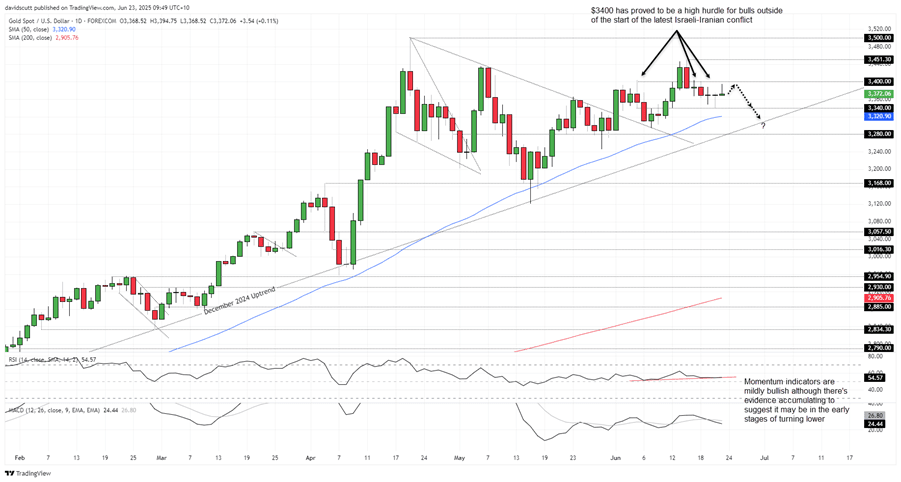
In recent times, amidst fluctuations off its peak values and a recovery in risk assets, the reaction of gold to tensions in the Middle East has been notably subdued. Such a restrained response signals a potential loss of momentum, with the $3400 mark standing as a formidable barrier. This poses a dilemma for investors bullish on gold, pressing the need for a new catalyst to revive their enthusiasm.
An Overview of Gold’s Performance
Traditionally, gold has been perceived as a safe haven during times of geopolitical unrest. However, its current performance deviates from expectations, hinting at a possible downward adjustment in the short term unless there is a significant escalation in Middle East tensions. The rebound of riskier asset classes from their lows, coupled with a retreat in crude oil prices from their initial surge, suggest a diminished urgency among investors to seek refuge in traditional safe havens, a deviation from historical precedents.
Gold’s Challenge at the $3400 Mark
A closer examination of gold’s price action on a daily basis reveals a hesitant advance towards $3400 per ounce, a level it struggled to surpass. The inability to breach this key resistance level aligns with earlier instances within the same month, notably excluding the bullish breakout on June 13, a direct consequence of Israel’s military actions against Iranian assets.
The price retreat from this resistance threshold speaks volumes about gold’s current market sentiment, posing the question of what would be needed for gold to revisit its peak levels achieved earlier in the year. Evidently, the triggers over the recent weekend fell short of catalyzing such a retest.
Despite Middle East tensions, technical indicators such as the Relative Strength Index (RSI) and the Moving Average Convergence Divergence (MACD) only exhibit mild bullish signals. Interestingly, a downcross in the MACD highlights a potential shift in market momentum towards the bearish spectrum.
The $3400 level remains a significant focal point for market observers. Surmounting this barrier could invigorate bullish sentiments, possibly aiming for the highs of June 16 at $3451.30 or even stretching to the $3500 mark. Conversely, failure to overcome $3400 could offer a strategic point for initiating short positions, with protective stops placed above this level. The pivot of $3340 stands noteworthy, having served as both support and resistance, pinpointing a feasible initial target for bearish bets. A breach here could see gold facing robust tests against the 50-day moving average and the upward trend since December 2024.
Expanding the Context
Understanding the current dynamics at play within the gold market requires a broader comprehension of its historical role and responses to geopolitical tensions. Gold has long been treasured not only for its physical beauty and use in jewelry and ornaments but also for its function as a financial asset. Historically, during periods of political instability, war, or financial turmoil, investors have turned to gold as a ‘safe harbor’ due to its enduring value.
The Middle East, being a region fraught with longstanding conflicts and tensions, often influences global markets, particularly oil and gold. Investors typically monitor developments in this area closely, given its potential to impact the stability of financial markets. Gold’s recent unremarkable response to tensions in the Middle East underscores a complex interplay of factors currently influencing global finance, including changes in monetary policy, inflationary pressures, and the diversification of investment portfolios beyond traditional safe havens.
Moreover, the evolving landscape of digital finance and cryptocurrencies has introduced new dynamics into the investment world, challenging traditional views on safe-haven assets. Despite these changes, gold’s historical reputation as a store of value in tumultuous times remains intact, albeit its allure may wax and wane based on geopolitical and economic developments.
As geopolitical tensions unfold and economic indicators signal changing seasons, the course for gold remains uncertain. Investors and traders alike must navigate these turbulent waters with a keen eye on both historical wisdom and emerging trends, balancing the allure of gold against a mosaic of global factors. Whether gold can reclaim its peak or faces further tests awaits on the interplay of market forces and geopolitical developments, painting a complex narrative for one of humanity’s oldest treasures.
