



On a recent Sunday, the opening of the market witnessed significant fluctuations, creating a scenario where the majority of assets encountered price adjustments. Despite efforts to bridge these gaps through the retraction of prices, the market valuations remained notably different from the closing figures observed the previous Friday, with the foreign exchange market being no exception to this trend.
Over the past week, there has been a discernible shift towards selling positions against the US dollar. This trend began to crystallize as the dollar experienced a notable drop, reaching a low of 97.69. This movement laid the groundwork for a series of rapid changes in the Forex markets particularly noticeable from mid-May to the start of June. During this period, a resurgence in the selling of the USD was observed, leading to a substantial ascent in the EUR/USD exchange rate from 1.1140 to a peak of 1.1610.
The backdrop of military conflicts significantly revived discussions around the USD in the wake of such volatility. Consequently, there’s been an urgency to reassess and identify pivotal levels for the most traded currency pair, the EUR/USD, taking into account the unfolding market dynamics.
A comprehensive analysis spanning from daily to intraday charts helps to shed light on the current state and potential future movements of the EUR/USD pair.
EUR/USD Daily Chart Analysis
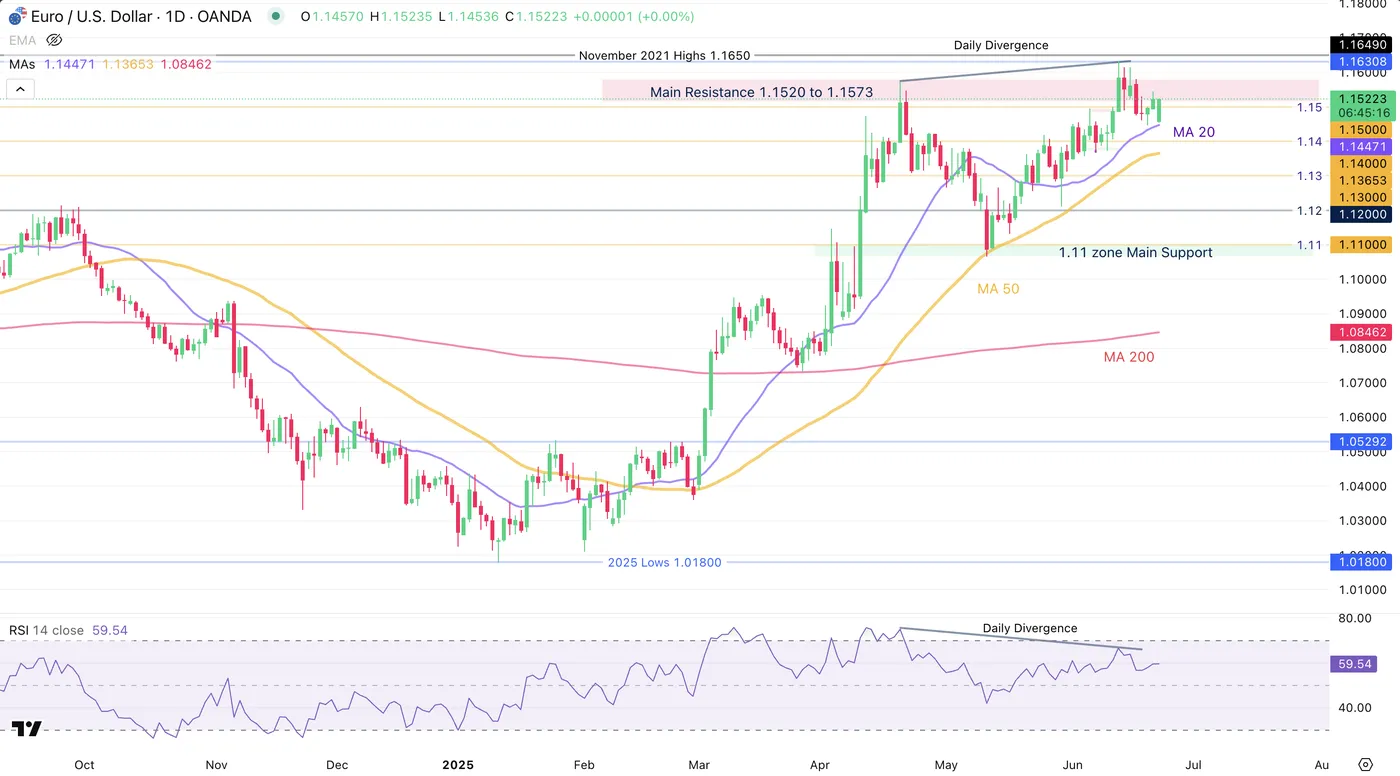
The EUR/USD pair faced resistance after peaking at 1.1630, despite continuous attempts to consolidate around this significant level in the previous weeks. A noteworthy observation is the formation of a divergence on the Daily Relative Strength Index (RSI), indicating an underlying weakness in the previously bullish trend that prompted a period of correction.
Investors utilised the 20-Day Moving Average as a springboard to lift the currency pair into the main resistance zone, identified between 1.1520 and 1.1573. While the Daily 50 and 200 Moving Averages, sitting at 1.1350 and 1.0850 respectively, suggest there is still room for adjustment in the event of a compelling sell-off, such a scenario seems distant from the current landscape.
EUR/USD 4-Hour Chart Insights
In the four-hour chart, the resurgence of mean-reversion buying has ignited a strong bullish movement. The failure of sellers to maintain control beneath the 1.1450 support level has catalyzed a vigorous rally, aiming towards and beyond the main resistance area.
Momentum appears robust, with the RSI climbing beyond the neutral threshold and decisively piercing through the 4H MA 50. Should the currency pair retrace beneath this average, it might signal a shift in control back to the sellers.
EUR/USD 1-Hour Chart Perspectives
The hourly chart reveals an imminent challenge as the price approaches the 1.1550 pivot zone, alongside the mid-May upward trendline. For buyers to sustain their advantage, they must push beyond this junction to challenge the 1.16 psychological barrier.
A failure to achieve this could entice sellers to reinvade, initially targeting a return to the overnight lows, with a potential further decline towards the 1.14 psychological mark.
Safe Trades!
This detailed analysis provides a foundational understanding for both seasoned traders and those new to the financial markets. The recent dynamics in the EUR/USD pair illustrate not just the impact of geopolitical tensions on currency values but also the importance of technical analysis in navigating the Forex markets.
While the geopolitical underpinnings that influence these market movements extend beyond the purview of this article, it is crucial to acknowledge that such tensions often introduce volatility and unpredictability in the financial markets. As these developments unfold, investors and analysts alike must remain vigilant, leveraging both technical and fundamental analysis to guide their decision-making process.
This expansive dive into the intricacies of the EUR/USD exchange rate dynamics showcases the interplay between geopolitical tensions, market sentiment, and technical indicators. As the global narrative shifts, the dialogue surrounding the US dollar and its counterparts will undoubtedly continue to evolve, reflecting the constant ebb and flow characteristic of the foreign exchange market.
