The Recent Surge in Oil Futures: An In-depth Analysis
Since December 20, 2024, the oil market has witnessed a notable upswing, entrenched in a complex interplay of geopolitical, environmental, and financial factors that underline the delicate balance of global energy economies. A confluence of changing weather patterns across Europe and the United States and anticipations of economic interventions by China has breathed new life into oil futures, elevating prices from a sturdy buying support found at $68.46. This analysis delves into the multifaceted dynamics shaping the current trends in oil trading, offering insights into the technical thresholds that could influence future market movements.
The Catalysts Behind the Surge
The genesis of this upward trajectory in oil futures can be traced to an amalgamation of external pressures and opportunities. Central to this is the evolving climate paradigm, with harsh weather conditions threatening production stability. The heart of the matter lies in the strategic shifts of oil companies, moving their focus away from the traditional bastions of the North Sea in pursuit of newer, potentially more lucrative basins. This strategic pivot has initiated a gradual downturn in production rates, casting a long shadow over future supplies.
Moreover, the spectre of cold weather forecasting spells potential jeopardy for oil and gas fields, particularly in the event of freezing conditions which could cripple production capabilities. The implications of this are twofold, entailing not just a tightening of supplies but also vulnerabilities in the pipeline infrastructure that could be exacerbated by freezes. Additionally, the oil market is bracing for the policy orientation of President-elect Donald Trump, who is set to assume office on January 20, 2025. His well-documented scepticism towards wind energy and criticism of the British government’s energy strategies underscores a potentially pivotal juncture for oil futures, with his advocacy for revitalising the ageing North Sea oil and gas sectors and disdain for wind farms signaling a potential shift in energy policies.
Technical Analysis and Market Forecasts
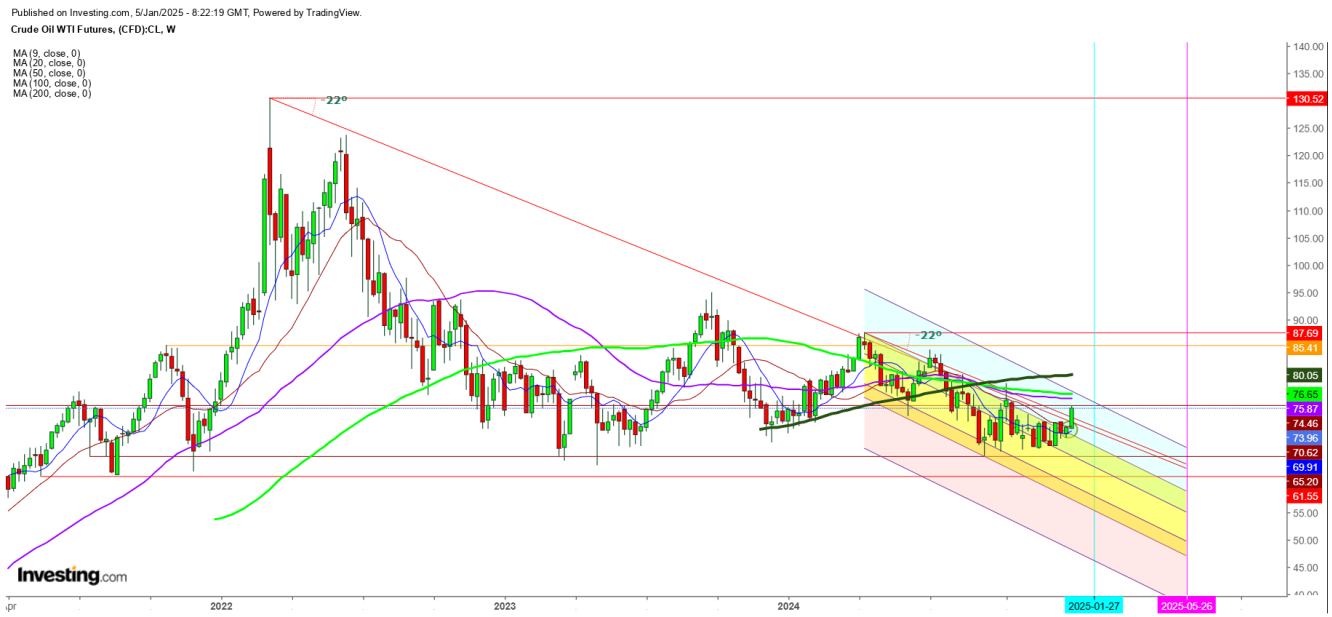
Navigating the currents of the oil futures market requires a discerning analysis of technical indicators and market trends. The recent breakout in oil futures, while promising, approaches a critical juncture at which the market teeters on the edge of pivotal technical levels. Specifically, the market’s proximity to the 100 Day Moving Average (DMA) poses a critical threshold. Historically, the bearish crossover of the 100 DMA below the 200 DMA has foretold a downtrend, setting the stage for the current market dynamics where the price hovers just below $80.
The Weekly and Daily Technical Outlook
The weekly charts have illuminated a pathway out of a previously narrow trading range, heralding a potential for further ascents. However, this optimism is tempered by the looming resistance poised at the 200 DMA, representing a significant barrier to sustained upward movement.
On a daily scale, the formation of a ‘Bullish Crossover,’ wherein the 9 DMA and 20 DMA ascend above the 50 DMA and 100 DMA, has catalysed a robust price surge. Yet, this bullish narrative is challenged by the emergence of a ‘Bearish Flying Doji’ pattern, indicating possible reversals and fresh selling pressures, especially as prices linger below the critical resistance of the 200 DMA at $75.55.
Strategic Implications for Traders
For traders navigating the volatile seas of oil futures, the current market presents both opportunities and cautions. The potential for prices to climb towards the $80 mark exists, yet the precarious balance at the 100 DMA highlights the risk of downward corrections. As President-elect Donald Trump’s tenure approaches, the market remains watchful of the potential policy shifts and their ramifications on the global energy landscape.
Disclaimer
This analysis is furnished for the purpose of providing insights based on current market observations. Traders are advised to engage with the market based on their own due diligence and risk assessments. The intricacies of oil futures trading demand a nuanced understanding of both market trends and underlying geopolitical and environmental factors that could sway market dynamics.
In conclusion, the recent uptick in oil futures encapsulates a myriad of influences, from shifting energy policies to environmental challenges, all of which converge to shape the trajectory of oil prices. As the market looks ahead to the impending presidency of Donald Trump and the potential for policy shifts, the interplay of technical indicators and external factors will continue to guide the fortunes of oil futures.