





In the realm of finance and investment, a peculiar observation can be made: as apprehension escalates, so does the influx of visitors to financial blogs. This phenomenon mirrors the inherent human nature to seek guidance amidst uncertainty. Conversely, when there’s a general sense of complacency among traders, there manifests a noticeable decline in the engagement with these informational resources. However, amidst this fluctuation in audience interest, there remains a beacon of positivity. The financial markets are underpinned by a range of robust support mechanisms that help in weathering the tumultuous seas of trading.
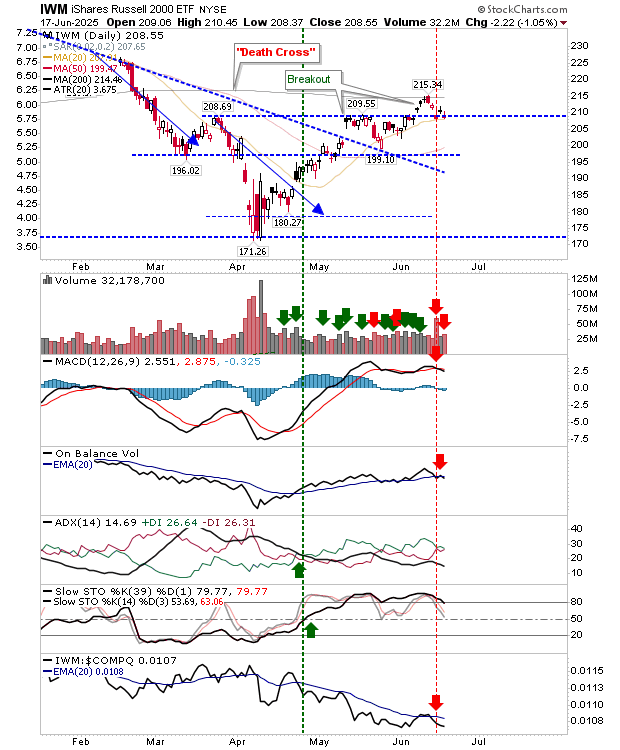
Taking a more granular look into the current state of the markets, it becomes evident that there has been a slight retraction to the 20-day Moving Average (MA) across different indices, propelled by relatively subdued trading volumes. This phenomenon, although not alarming, has been marked by technical distribution, indicating a shift in market dynamics. Specifically, the On-Balance-Volume (OBV), a momentum indicator that uses volume flow to predict changes in stock price, has flagged a ‘sell’ signal, augmenting a similar alert triggered by the 20-day MA’s performance.
The Standard & Poor’s 500 (S&P 500), a barometer for the U.S. equity market, mirrored this trend with a retraction to its 20-day MA, reminiscent of the market’s disposition the previous Friday. Despite this, the Moving Average Convergence Divergence (MACD), a trend-following momentum indicator, continues to hold firm to its May ‘swing’ signal. This is complemented by a dialling down of the stochastic oscillator from an overbought condition, suggesting a cooling-off period might be underway. It’s critical to underline that a genuine and sustained market breakout necessitates overbought stochastics. Moreover, an undermining of the 20-day MA position could potentially shift the focus towards the 50-day MA, diverting attention from the highs seen in February.
The Nasdaq Composite Index, earmarked for its heavy technology stock composition, presents a slightly different narrative. It exhibits a more solid footing in terms of technical indicators, notwithstanding a ‘sell’ signal from the MACD. Other metrics such as market momentum, however, paint a more resilient picture, suggesting a robust undercurrent that might be more impervious to transient market fluctuations.
Turning our gaze towards the cryptocurrency realm, Bitcoin, the vanguard of the digital currency universe, has been experiencing a lateral drift. The preceding day’s losses insinuate a lack of sufficient market demand to extricate Bitcoin from its current trading doldrums. There’s a burgeoning consensus that a fresh impetus, perhaps a challenge to the 200-day MA, could be the catalyst needed to rejuvenate its trade dynamics.
Whilst the past few days have not witnessed any substantial shifts within the markets, it’s imperative to acknowledge that the more protracted such stability is, the higher the probability of a significant market movement when it eventually transpires. This underscores the intrinsic unpredictability and dynamism that encapsulates financial markets.
To the uninitiated, these technical indicators and market movements might seem arcane, but they are foundational to understanding how the markets communicate. Essentially, indicators like the MA, MACD, and OBV serve as the market’s pulse, offering insights into the underlying health and potential direction of stock prices. The MA provides a smoothed account of price trends over a specific period, the MACD gauges momentum by illustrating the relationship between two moving averages of price, and the OBV combines volume and price to offer predictions on upward or downward movements.
Understanding these metrics is crucial for both seasoned traders and newcomers aiming to navigate the complexities of investing. In essence, while these indicators can guide decision-making, the markets invariably retain an element of unpredictability. It’s this interplay between calculated analysis and inherent market volatility that makes trading a challenging yet potentially rewarding endeavour.
In sum, the narrative of financial markets is one of continuous evolution, punctuated by moments of uncertainty and stability. Amidst this dynamically shifting landscape, financial blogs and analyses stand as vital resources for demystifying market trends and aiding investors in making informed decisions. As we journey further into the intricacies of market analysis, it becomes abundantly clear that staying informed and adaptable is paramount in the quest for financial success.

