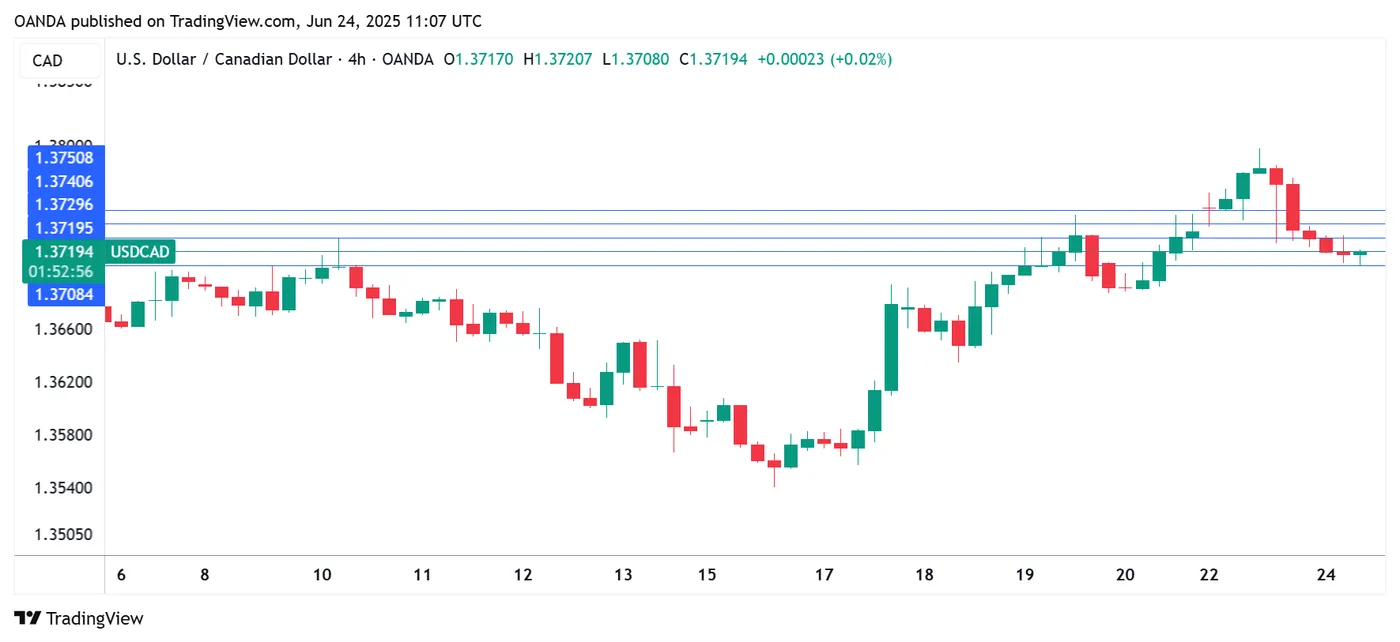
In recent financial developments, the Canadian currency has experienced a slight decline. During the European trading hours, it was observed trading at 1.3718 against the US dollar, marking a 0.12% decrease within the day. This subtle shift draws attention to the economic indicators set to be released and their potential impact on future monetary policy decisions in Canada.
Expected to be unveiled later in the day is Canada’s inflation report for May. This follows a period of economic ambiguity, particularly highlighted by April’s inconsistent inflation data. In April, the Consumer Price Index (CPI), a key measure of inflation, notably dipped to 1.7% from the previous 2.3%. This reduction was largely attributed to a decline in energy costs and the government’s decision to eliminate a consumer carbon tax. Concurrently, another crucial metric, the CPI Trimmed Mean, which offers an alternative perspective by excluding the most significant price movements, provided a surprising uptick in April, escalating to 3.1% from 2.9%.
For May, analysts have set the forecast for the headline CPI to remain stable at 1.7%, while expectations for the CPI Trimmed Mean are slightly adjusted, projecting a decrease to 3.0% from the 3.1% previously observed.
Amidst these developments, Tiff Macklem, the Governor of the Bank of Canada (BoC), has described the current state of inflation as “complicated.” Last week, he highlighted his concern over rising underlying inflation figures, suggesting that the ongoing trade tensions with the United States could be exerting upward pressure on inflation levels. This observation comes at a time when many central banks globally have adopted a cautious stance, primarily due to the unpredictability surrounding US tariff policies. Similarly, the recent escalations in tensions between Iran and Israel have amplified this cautious outlook, with the central bank opting to maintain its current policy stance during its last two meetings. The BoC is scheduled for another meeting on July 30, where further insights into its monetary policy direction could be revealed.
In related news, the geopolitical landscape has seen significant developments that have influenced global financial markets. Following a US-mediated ceasefire agreement between Israel and Iran, oil prices witnessed a roughly 2% decrease on Tuesday. Prior to the ceasefire, Iran had escalated threats of closing the Straits of Hormuz in response to US military actions targeting Iranian nuclear facilities. This situation had raised widespread concerns about potential disruptions to global oil supply chains. However, with the easing of these tensions, investors have regained a semblance of risk appetite, leading to notable gains against the US dollar for currencies often considered riskier, such as the Canadian dollar.
From a technical standpoint, the USD/CAD currency pair has demonstrated interesting movements. It has slipped below the previously established support level of 1.3739, now testing further support at 1.3729. Should this threshold give way, the next support level is identified at 1.3708. On the resistance front, markers are placed at 1.3740 and 1.3750, providing traders and investors alike with significant levels to monitor in the coming days.
As these financial and geopolitical narratives evolve, it’s critical for stakeholders to stay informed and prepare for the shifts that lie ahead in the global economic landscape. The intertwining of economic data releases, central bank policies, and international diplomatic relations highlights the complexity of the current financial environment, underscoring the importance of vigilant analysis and strategic planning in navigating these turbulent times.