In an astonishing turn of events that unfolded over the recent weekend, the geopolitical landscape witnessed a substantial shift that could have far-reaching implications, many of which seem to be underappreciated by the investment community. The United States has taken a bold and unprecedented action against Iran, launching airstrikes on the country’s nuclear facilities with B-2 stealth bombers armed with bunker-buster bombs. This aggressive move signals a formal entry by America into what is being described by many observers as the most perilous crisis in the Middle East in decades.
Amid escalating tensions, reports have emerged stating that the Iranian parliament has supported threats to close the Strait of Hormuz in response. The significance of this narrow waterway cannot be overstated – it is through this strait that approximately 20 million barrels of oil are transported daily, accounting for about a fifth of global oil shipments. The prospect of the strait’s closure, therefore, represents a critical threat to the global economy, with the potential to disrupt oil exports and trade severely. In effect, it is akin to strangling the world’s economic lifeline.
Against this backdrop of looming crisis, the behaviour of gold, typically regarded as the “safe haven” asset, is peculiar and indeed telling. Despite the potentially catastrophic repercussions of a full-fledged conflict in the Middle East – compounded by the direct military engagement of the U.S. and the threats to significant oil supply routes – gold’s market response has been unexpectedly subdued. In fact, in the week following the initial airstrikes by Israel on Iran, gold’s prices not only failed to surge but even saw a decrease of 2%, with a further drop of about $8 as trading resumed.
This response, or lack thereof, from gold is counterintuitive given its status as a refuge during times of geopolitical uncertainty and crisis. Historically, even the mere rumour of conflict between the U.S. and Iran would send gold prices soaring. However, the current situation, which far surpasses mere rumour in its severity, has not triggered the expected rally in gold prices.
What this indicates, beyond the immediate market dynamics, is a deeper shift in investor sentiment and perhaps confidence in gold’s role as a crisis asset. Despite facing what could arguably be considered the most severe geopolitical crisis since the Cuban Missile Crisis, investors are choosing to sell rather than buy gold. This could signal underlying bearish pressures in the gold market potent enough to outweigh even the prospect of a regional, if not global, conflict.
This phenomenon is not entirely unprecedented. In financial markets, when an asset fails to respond positively to events that should, in theory, boost its value significantly, it often presages a forthcoming decline. It suggests a fundamental issue, analogous to a rocket failing to launch despite being fully fueled. In the current context, the inertia in gold prices amidst escalating geopolitical tensions raises the question: if such dire circumstances do not catalyse a rally in gold, then what could?
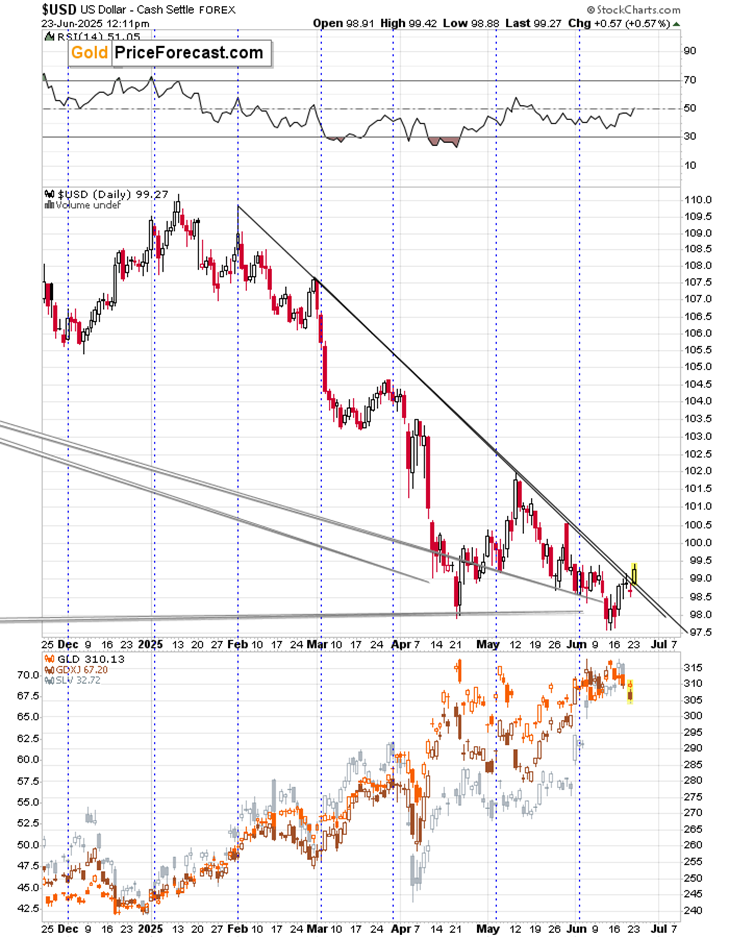
Parallel to the muted reaction in gold prices is the performance of mining stocks, particularly those associated with gold extraction and production. A glance at the VanEck Junior Gold Miners ETF, a notable indicator in this sector, reveals a similarly tepid response. The ETF is hovering close to its April high, showing a lacklustre reaction that suggests the potential for a significant downward correction.
In sum, the recent geopolitical developments, while intensely significant in their own right, also serve as a lens through which the changing dynamics of financial markets, particularly with respect to traditional safe havens like gold, can be observed. The underwhelming response of gold to what many would consider a perfect storm for a rally exposes underlying shifts in investor sentiment and market dynamics. This poses critical questions for the future of gold as a refuge asset and for the broader implications of geopolitical crises on financial markets. As the situation continues to evolve, the responses of both gold and the wider market will be crucial indicators of changing trends in global finance.