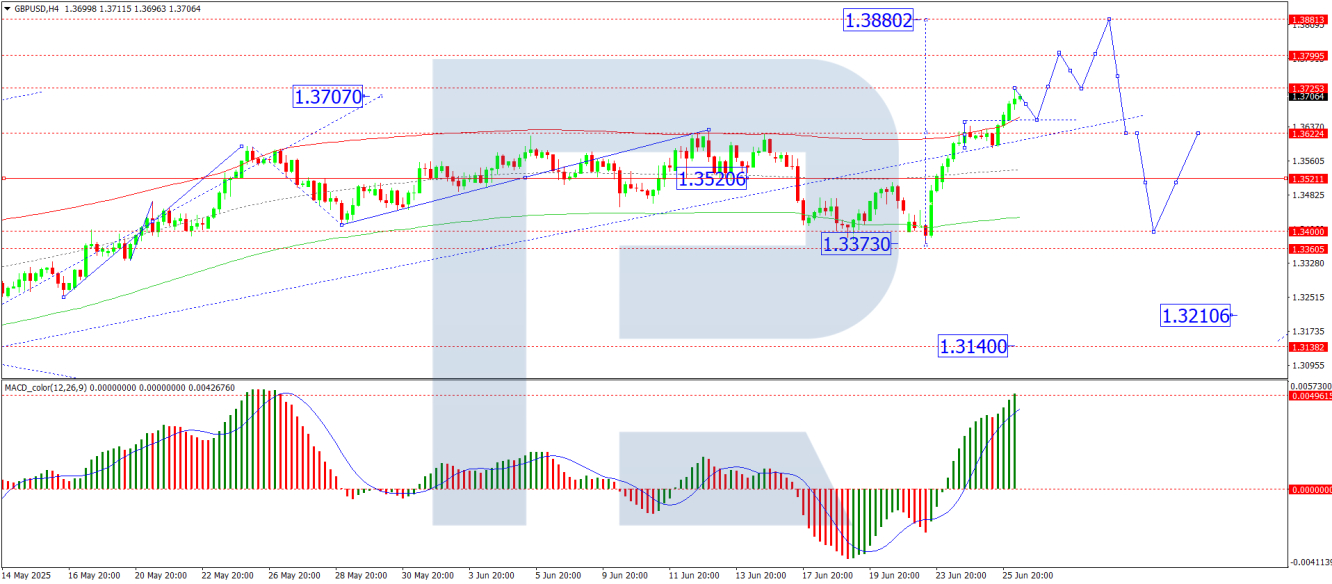
The British Pound (GBP) recently experienced a significant surge, reaching its highest point against the US Dollar (USD) since January 2022, with the currency pair hitting the 1.3704 mark. This notable rise can be attributed to a combination of weakening in the US Dollar, growing anticipation of monetary policy adjustments, and a de-escalation in geopolitical tensions.
The rallying of the Pound was propelled by expectations for a forthcoming reduction in interest rates by the Federal Reserve (Fed), further fuelled by comments from Fed Chair Jerome Powell. Powell hinted that a deceleration in labour market strength or economic performance might lead the central bank to implement quicker adjustments to its monetary policy. In the UK, signals from the Bank of England (BoE) added to the anticipations of rate cuts, with both Governor Andrew Bailey and Deputy Governor Dave Ramsden indicating such moves might be on the near horizon.
The dialogue concerning potential rate adjustments in the UK emerged against a backdrop of cooling labour market indicators. Governor Bailey and Ramsden pointed to the slowing pace of wage growth and an increase in economic inactivity as primary factors. Nonetheless, Bailey also expressed reservations about the reliability of recent employment figures. Deputy Governor Ramsden, who had cast his vote in favour of a rate reduction, emphasized the slowdown in the labour market as a pivotal reason behind his decision, also highlighting the risk of inflation falling beneath the central bank’s 2% target.
In a broader context, the recent easing of geopolitical tensions, particularly the truce between Israel and Iran, has contributed to a lessening of fears regarding potential inflationary shocks and further escalations. Such international developments play a crucial role in shaping market sentiments and can significantly affect currency valuations.
From a technical standpoint, analysis of the GBP/USD pair reveals insightful trends. On the four-hour (H4) chart, the pair demonstrated a period of tight consolidation around the 1.3622 level before making a pronounced move upwards. This break above the upper boundary of a pre-existing consolidation range suggests a potential for further upward movement. Technical analysts have identified the next target for the pound at the 1.3880 mark, with supportive signals emanating from the Moving Average Convergence Divergence (MACD) indicator, which continues to trend above zero in an upward trajectory.
A closer examination of the one-hour (H1) chart further elucidates the pair’s dynamics, showing a completed upward wave to 1.3723. According to this analysis, a minor pullback towards 1.3630 may occur before another rally potentially drives the pair towards 1.3810. This anticipated movement finds corroboration in the Stochastic oscillator’s signal line, which, descending towards 20 from below 80, supports the prospect of a brief correction followed by continued gains.
In conclusion, the surge in the GBP/USD pair mirrors the confluence of factors such as the weakening US Dollar, expectations of rate cuts by the Bank of England, and diminishing geopolitical risks. While technical indicators provide a promising outlook for the Pound, suggesting potential for further appreciation following a succinct correction, it is imperative for traders and investors to approach these forecasts with caution. As delineated by the analytical department of RoboForex, these analyses represent the perspectives based on current market dynamics and are not to be misconstrued as direct trading advice. Market participants should also be aware that trading outcomes may vary, and the responsibility for such results lies solely in the hands of the trader, independent of analyses and recommendations provided herein.