





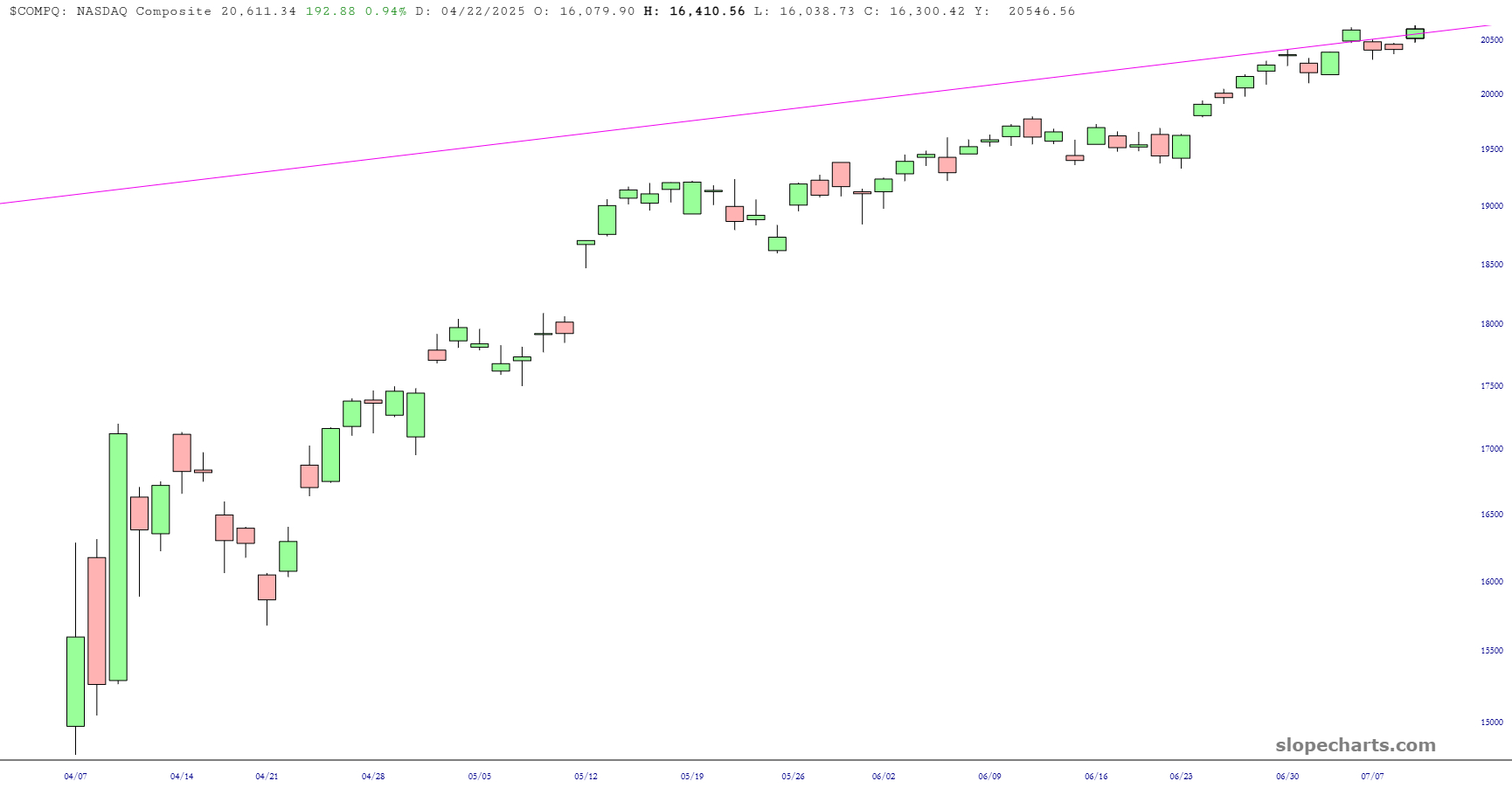
After a considerable wait of almost an hour for the commencement of the Grok 4 livestream, a sense of anticipation turned to disappointment as the event failed to go live. This led to a moment of reflection on the current state of the market, which has seen a notable uptrend since April 21st, displaying scarcely any signs of a downturn. The impact of this trend has been keenly felt, with my investment engagement at a mere 73% as of Wednesday’s close. More starkly, one of my portfolios stood at a paltry commitment level of 23%, a situation that is disheartening to say the least.
Over the last three months, a glance at any major index chart reveals a market that has not only consistently trended upward but has done so with a predictability and smoothness that are, quite frankly, disheartening. It’s a situation that lends itself to a sense of frustration for those looking for volatility or downturns as opportunities.
Consider the NASDAQ Composite, NASDAQ 100, S&P 100, and S&P 500 indices. Each of these has charted an upward trajectory that underscores the broader market’s resolute path to growth. Alongside this, volatility, as measured by indices such as the VIX, has seen a significant reduction, reaching a quarter of its level from early April and hitting a 15-handle for the first time since February. This reduction in market volatility is complemented by sentiment indicators like the CNN Fear/Green Index, which has recently moved into a zone of EXTREME GREED, an occurrence that has been absent for some time.
This backdrop sets a stark stage for market observers and participants. The continuous ascent of the market, coupled with reduced volatility, paints a picture of a market environment that is less about the ebbs and flows and more about a sustained upward movement. This environment can be challenging for those seeking opportunities in market corrections or downturns, essentially adding “salt to the wounds” of these observers.
For a broader understanding, it’s essential to delve into why market dynamics such as these matter. The financial markets are often a reflection of underlying economic conditions, investor sentiment, and future expectations. When indices continually ascend, it suggests a general optimism or perhaps a lack of alternative investment opportunities that drive capital into the stock market, pushing prices higher. This can lead to concerns about overvaluation or speculative bubbles, where prices are driven more by investor behavior than by fundamentals like company earnings or economic growth.
Moreover, volatility is a double-edited sword in the financial markets. On one hand, low volatility and a steadily climbing market can provide a sense of stability and predictability, encouraging more participation from retail and institutional investors alike. On the other hand, it can also signal complacency, where the lack of price fluctuations might mask underlying risks or lead to an underestimation of potential downturns.
The situation as it stands, with indices charting new heights and sentiment indicators showing extreme greed, is a clarion call for caution. It beckons market participants to look beyond the surface of the current market euphoria and to consider the sustainability of this upward trajectory. For those with a keen eye on the markets, it’s an environment that demands vigilance and a readiness to adapt to changing conditions.
As we navigate this landscape, it’s crucial to understand the elements at play. Financial markets are complex systems influenced by a myriad of factors including but not limited to economic policies, corporate performance, geopolitical tensions, and technological advancements. The current state of the market, with its steady climb and reduced volatility, could be seen as a momentary phase within a larger cycle. Understanding this context is vital for both seasoned investors and newcomers alike, as it frames expectations and informs investment strategies.
In conclusion, the financial markets are currently traversing a period of sustained growth and low volatility, a condition that brings with it both opportunities and cautionary tales. For those looking in from the sidelines, it’s a time for diligent analysis and strategic planning, keeping in mind the cyclic nature of markets and the inevitability of change. Whether this phase is a precursor to a more tumultuous period or a new normal remains to be seen. However, one thing is certain: the landscape of the financial markets is ever-evolving, and staying informed and adaptable is key to navigating its complexities.

