Over recent days, the foreign exchange markets have exhibited a lull akin to a seasonal hiatus, with the majority of major currency pairs witnessing movements confined within a narrow span of 300 pips. This phase of tranquility, however, might witness a stir as the US dollar shows signs of revitalization. The impetus behind this potential shift in dynamics deserves a closer investigation, particularly in light of the latest economic indicators and geopolitical developments that are shaping the landscape.
A remarkable piece of data that has caught market participants’ attention is the most recent report on US jobless claims. Contrary to expectations which pegged the figures at 235,000, the actual reported number was slightly lower at 227,000. This deviation from the forecast not only underscores the robustness of the United States’ labor market but also serves as a testament to its resilience. The uptick observed in jobless claims in mid-June seemed to raise concerns about the stability of employment; however, the recent data suggests that the increase was a temporary blip rather than the onset of a worrying trend.
In another dimension of the economic arena, trade policies, especially those pertaining to tariffs, have been making headlines. The announcement of imposing a 50% tariff on steel imports is an audacious move, ostensibly aimed at rejuvenating the domestic industrial sector. However, the logic behind burdening the same industries with higher import costs seems tenuous at best. These measures, alongside the imposition of similar tariffs on Brazilian exports, encapsulate a series of controversial decisions made by the Trump administration, leaving the markets to acclimate to such unpredictable policy frameworks.
As the market’s gaze turns towards the upcoming US inflation report, there’s an air of anticipation about how these figures will influence the Federal Reserve’s stance on monetary policy, and in turn, the value of the US dollar.
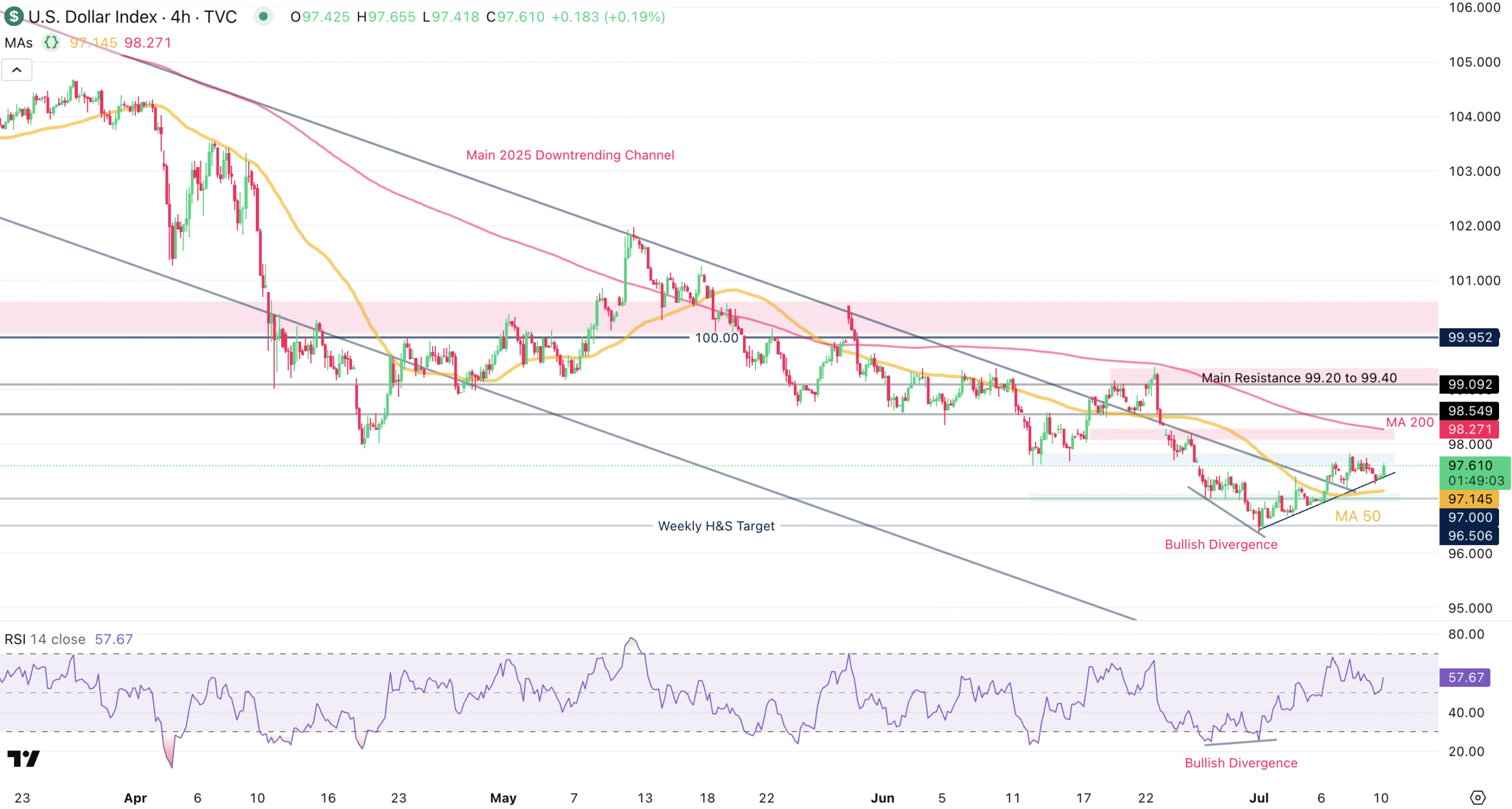
Delving into the technical analysis of the Dollar Index (DXY), an upward trajectory is palpable. From a broader perspective, the DXY has successfully exited its descending channel, a trend that commenced in 2025, revealing bullish divergences with recent lows. This breakout is of particular significance as it indicates a potential shift in market sentiment and could herald the inception of new trends in the latter half of the year. The distancing from perpetually bearish positions against the dollar, sparked by its declivity in the initial months and juxtaposed with the surprisingly strong US data, cultivates a fertile ground for debate on the Federal Reserve’s capacity to implement rate cuts.
Observing the index on a more granular level, specifically the 1-hour chart, the dollar’s ascendance is further corroborated by buyers capitalizing on a bullish trendline from recent lows to retest weekly pinnacles. While the momentum is notably robust, breaching the 1H MA 50, it is imperative for this movement to decisively break through in either direction to evade stagnation within a restricted 45 pip range.
To adeptly navigate these waters, traders should keep a vigilant eye on several critical junctures:
Support Zones:
- The existing lower boundary of the range: 97.20
- The foundational support of the current consolidation zone: 97.00
- The nadir of 2025: 96.50
Resistance Zones:
- The immediate turning point: 97.60 to 97.80
- The incumbent resistance sphere: 98.00
- 4H MA 200 at 98.20
- The paramount resistance band: 99.20 to 99.40
As these intricate dynamics unfold, market participants are poised at the cusp of potentially significant trends that could redefine the trajectory of the US dollar in the time ahead. Amidst these speculative tides, one can only underscore the virtue of prudence in navigating the forex markets.
Such a period in the financial markets underscores not just the inherent unpredictability that traders and investors must navigate, but also the profound impacts of geopolitical and economic shifts on currencies. The role of data, policy decisions, and their interpretations magnifies in this context, weaving a complex tapestry that requires both keen insight and caution. As we proceed, it is these developments that will dictate the rhythm of the financial markets, providing both challenges and opportunities in equal measure.