





In recent times, the financial markets have been navigating through a phase of cautious optimism mixed with a tinge of apprehension, primarily due to the looming shadows of tariff impositions and their potential repercussions. On a more granular note, the narrative around the stock market has taken a curious turn with the latest updates on tariff news, especially concerning a proposed 35% tariff on Canada which has stirred the pot of market uncertainty.
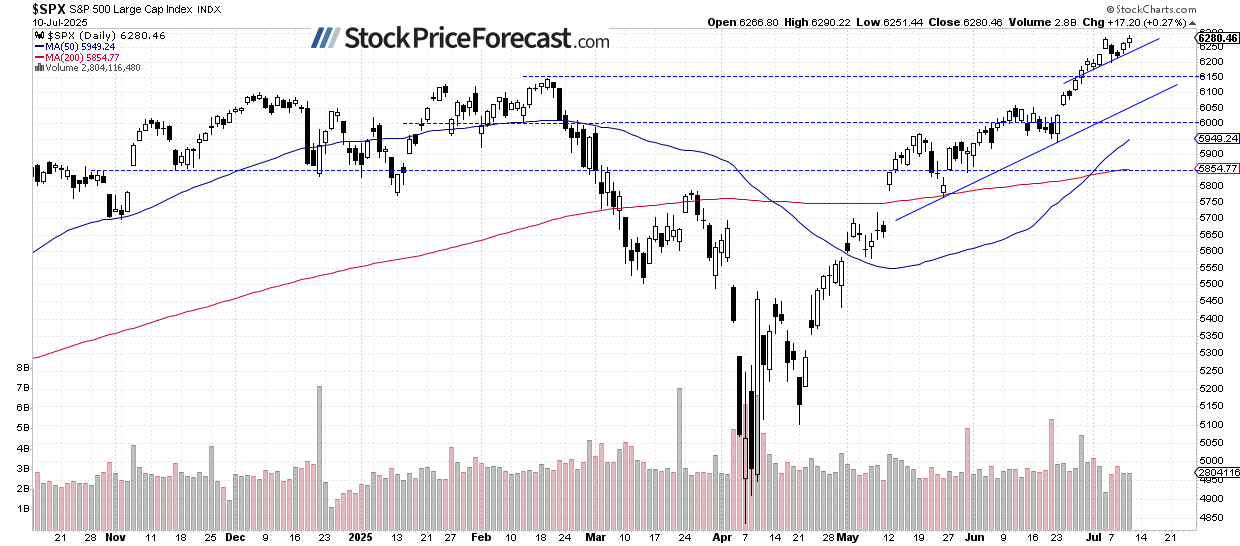
The equity markets, particularly in the United States, have been on a trajectory of consolidation, with the S&P 500 Index marginally elevating by 0.27% on a Thursday, settling at a slightly higher zenith of 6,290.22. This movement underlines the market’s ongoing short-term consolidation phase. However, the news that broke overnight regarding the significant tariff on Canada has set the stage for the market to open approximately 0.5% lower, as indicated by the futures market.
Investor sentiment, as gauged by the AAII Investor Sentiment Survey on Wednesday, remains buoyant with 41.4% of individual investors leaning towards bullishness while 35.6% harbour bearish sentiments. Despite these sentiments, the S&P 500’s proximity to its all-time high encapsulates a story of resilience and underlying strength in the face of economic uncertainties.
However, not all indices share the same narrative. The Nasdaq 100, on the other hand, experienced a slight decline of 0.16% on the same Thursday, slightly underperforming relative to the broader market. This index seems to be in a consolidation period within an ongoing uptrend. Although there are no visible negative signals, the price movement hints at a potential topping pattern, adding a layer of uncertainty to its future direction.
Amidst these market dynamics, the Volatility Index, commonly referred to as VIX, dipped to a new local low of 15.70, providing further evidence to support the strength of the equity rally. Historically, a decreasing VIX suggests a reduction in market fear, conversely, a rising VIX is synonymous with stock market downturns. This inverse relationship highlights the peculiar nature of market sentiment and volatility.
The S&P 500 Futures Contract has not been immune to the market’s speculative movements, trading slightly below the 6,300 mark after rebounding from an overnight dip triggered by the announcement of President Trump’s tariffs. The consolidation observed could either indicate a topping pattern or a flat correction paving the way for another upward movement. That said, the resistance and support levels at 6,320 and 6,250, respectively, continue to play crucial roles in shaping market expectations.
Shifting the lens to the crude oil market, Thursday’s closing saw a 2.65% decline, with prices falling below the $67 mark and extending the recent consolidation phase. This decline was a reaction to a surprising inventory build, notwithstanding, the morning after saw oil prices trading 0.9% higher. The oscillations in the oil market are a testament to its volatile nature, influenced by an array of factors including, but not limited to, the IEA’s comments on the oil market being tighter than perceived driven by robust summer demand, OPEC+ production hikes, and diverging long-term outlooks from IEA and OPEC.
In summary, the financial landscape is bracing for a lower opening following the recent record high. While the market does not exhibit overtly bearish signals, short-term profit-taking cannot be ruled out. This air of caution is also tinged with anticipation for the upcoming quarterly earnings season which is expected to commence next week with major banks unveiling their reports. As the markets hinge on a delicate balance between optimism and uncertainty, investors continue to navigate through these turbulent times, armed with insights and informed speculations on future movements.

